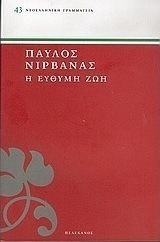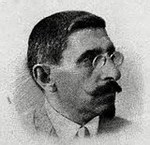
Paylos Nirvanas
Pavlos Nirvanas (1866-1937, the literary pseudonym of Petros Apostolidis) was born in Mariupol, Russia, the son of merchant Konstantinos Ap. Koumiotis from Skopelos and Marietta Io. Rallis from the well-known family of Chios. During his childhood, he moved with his family to Piraeus, where he completed his general education. He studied at the Medical School of the University of Athens (1883-1890) and, after graduating, joined the royal navy as a junior doctor. His career progressed, and by 1922, when he resigned with the rank of chief medical officer, he had served as president of the Supreme Health Committee of the Navy and head of the Naval Ministry's department. After his resignation, he dedicated himself to journalism and writing. In 1928, he became a member of the Academy of Athens. He died in Athens at the age of sixty-one. From his school years, he showed a love for literature and, at a young age, published articles in the Piraeus newspapers "Sfera" and "Pronia." Nirvanas made his official literary debut in 1884 with the publication of the poetry collection "Daphnae on the 25th of March." Simultaneously, he began publishing chronicles (in the newspapers "Asty," "Acropolis," and from 1905 in "Estia" under the pseudonym Mr. Asophos) and texts in literary magazines of the time ("Techni," "Panathinaia," "Nea Estia," "To Periodikon Mas," "Asmodaios," "Mi Chanesai," etc.). At a young age, he also participated in the publication of the satirical magazine "Athinai" as a member of the literary Society of Twelve. His second and last poetry collection was titled "Paga Laleousa" (1907), and he also wrote studies, critical essays, short stories, plays, and two translations from Plato and Knut Hamsun. Pavlos Nirvanas is placed both chronologically and based on his body of work within the circle of Kostis Palamas. His writing is influenced by the European artistic movements of aestheticism and symbolism, as well as the philosophical thought of Friedrich Nietzsche, which he first encountered through the pages of "Techni" by Kostas Chatzopoulos, where he was a co-founder. His critical essays are noteworthy, while in prose, he initially focused on short stories and later on novels. His prose work is dominated by ethnographic and psychographic elements, while his plays follow the patterns of Ibsen's writing. The influence of Nietzsche's philosophy is strongly evident in his work. His linguistic expression gradually transitioned from formal Greek to a mixed language and finally to the demotic, consistently characterized by an exceptionally refined style. In 1928, he was appointed a member of the Academy of Athens, from which position he contributed to the recognition of writers such as Ioannis Kondylakis, Spyros Melas, and Grigorios Xenopoulos. He died of bronchopneumonia at his home in Maroussi. For more biographical details about Pavlos Nirvanas, see Tellos Agras, "Nirvanas Pavlos," in the "Great Greek Encyclopedia," vol. 18, Pyrsos, 1932 (republished in the volume Tellos Agras, "Critics, Third Volume," of the series "Forms and Texts of Our Prose," edited by K. Stergiopoulos, Hermes, 1984), G. Valetas, "Biographical-Chronological Table," in "Complete Works of Pavlos Nirvanas," vol. A, Athens, 1967, M. G. Meraklis, "Pavlos Nirvanas," in "Greek Poetry: Romantics - The Era of Palamas - Post-Palamas: Anthology, Grammar," Sokolis, 1977; Dimitris Giakos, "Nirvanas Pavlos," in "The Great Encyclopedia of Modern Greek Literature," vol. 10, Haris Patsis, n.d.; Alexandros Argyriou, "Nirvanas Pavlos," in "World Biographical Dictionary," vol. 7, Ekdotiki Athinon, 1987; Marianna Ditsa, "Pavlos Nirvanas," in "Our Older Prose: From Its Beginnings to the First World War," vol. IX (1900-1914), Sokolis, 1997; and Vasilis D. Anagnostopoulos, Eudokia Paradeisi, "Nirvanas Pavlos," in "Dictionary of Modern Greek Literature," Patakis Publishers, 2007.
(Source: Archive of Greek Authors, EKEBI).
 Greek Fiction Books
 Greek Fiction Books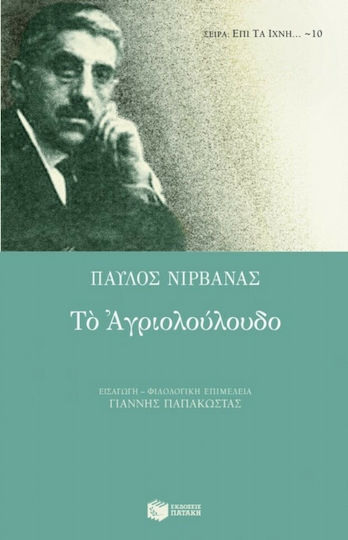
 Greek Fiction Books