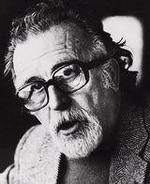
Manolis Andronikos
Manolis Andronikos, a Greek archaeologist, was born in Bursa in October 1919. Later, he and his family settled in Thessaloniki. He studied at the Faculty of Philosophy at the University of Athens. He later became a professor of Classical Archaeology at the Aristotle University of Thessaloniki in 1952. He furthered his studies at Oxford with Sir John D. Beazley (1954-1955). He served in the Archaeological Service. In 1957, he was elected as a lecturer in Archaeology (University of Thessaloniki), in 1961 as an associate professor of the second chair of Archaeology, and in 1964 as a full professor in the same chair.
He was married to Olympia Kakoulidou. He had a deep love for the arts and literature. He was an avid reader and a founding member of the association "Art."
He conducted numerous excavations in Veria, Naousa, Kilkis, Chalkidiki, and Thessaloniki, but his main excavation work was concentrated in Vergina, where he unearthed the significant cemetery of tumuli from the Geometric period. He continued, in collaboration with G. Bakalakis, the excavation of the Hellenistic palace that K. A. Romaios had begun in 1937. The pinnacle of his career is considered to be November 8, 1977, when in Vergina he brought to light one of the most important archaeological monuments, the royal tomb of Philip II, King of Macedonia. The tomb was untouched, with invaluable findings. This was also one of the great archaeological discoveries of the 20th century on a global scale. Manolis Andronikos passed away on March 30, 1992.
 Scientific Books