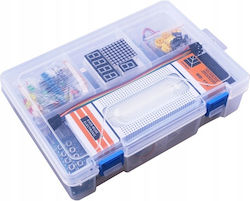
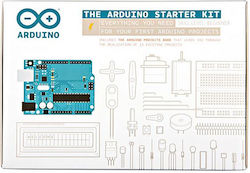
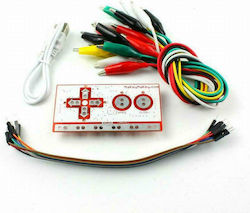
Kit: Packages that include the main board, guides, and a variety of components (wires, sensors, LEDs); ideal for beginners who want to learn programming and electronics.
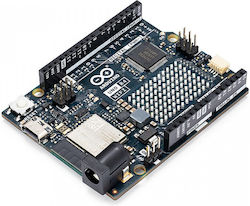
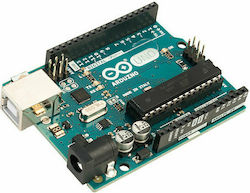
Boards: The main boards-microcontrollers (e.g. Arduino Uno, Nano, Mega) that serve as the "brain" of your project, where you upload your code.
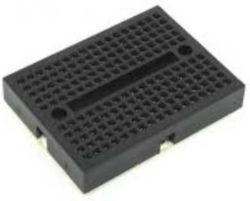
Accessories: Additional essential items such as protective cases, power cables, battery holders, and breadboards for your experiments.
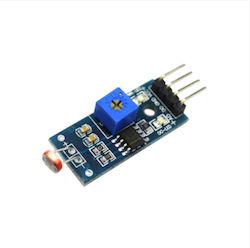
Module: Ready-made small circuits with specific functions (e.g. modules for Wi-Fi, Bluetooth, relays, or motion sensors) that can be easily connected to the main board.
Shields: Expansion boards that fit directly on top of the main Arduino board (like a "floor"), instantly adding new features (e.g. Ethernet shield, Motor shield).
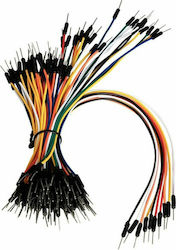
Jumper: Special flexible wires with terminals (male or female) for quickly connecting components together without soldering.
Breakout Boards: Tiny boards that "carry" a very small chip (e.g. a sensor) and bring its connections out to more convenient pins, so you can easily connect it with wires.
Mega: The largest board in the family with the most ports (pins) and memory. Ideal for complex projects, 3D printers, robotics, and robotic arms.
Nano: The smallest and most compact Arduino board. It offers almost the same capabilities as the Uno, but in a micro size, suitable for permanent installations and small spaces.
Uno: The most popular and classic Arduino board. It is the standard for beginners, students, and school projects, as it has the largest online community and ready-made code examples.
ESP32: Powerful next-generation processor with built-in Wi-Fi and Bluetooth. The top choice for advanced IoT (Internet of Things) projects and smart home automation.
ESP8266: Affordable and very popular processor with built-in Wi-Fi. Ideal for connecting your projects to the Internet (e.g. sending weather data or remote control).
ATmega328P: The classic, reliable microcontroller used in the Arduino Uno. Ideal for basic electronic projects, automation, and learning programming without the need for Internet access.
NodeMCU: Ready-made development board based on the ESP8266 Wi-Fi chip. Combines the capabilities of the Internet with the ease of programming of an Arduino.