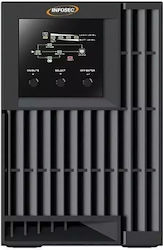
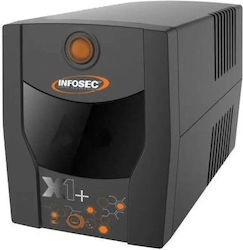
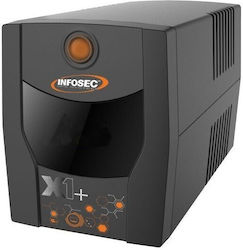
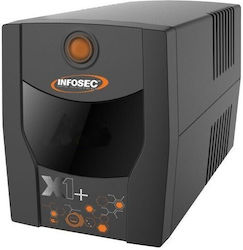
Low (Up to 500W): Ideal for home use or small offices. They cover PCs, routers & small devices.
Medium (501W - 1500W): Ideal for home use, professional spaces, small businesses, SOHO (Small Office/Home Office). They cover 1-2 PCs, small servers, telecommunications equipment, NAS.
High (1501W - 3000W): Suitable for medium-sized businesses and small data centers. They cover larger servers, professional security systems, telecommunications systems.
Very High (3001W+): For large businesses, data centers, hospitals, industrial applications. They cover powerful production machines, large networks, and infrastructures with high energy demands.
(VI) Line-Interactive: They continuously adjust the output voltage through the automatic voltage regulator. They provide satisfactory protection against voltage fluctuations as well as power outages.
(VFI) On-Line/Double Conversion: They offer maximum protection against voltage fluctuations and power outages. They are recommended for sensitive devices and equipment.
(VFD) Off-Line: Basic protection is designed to provide power in case of power outages and not for fluctuations in current voltage. It is not recommended for sensitive equipment.
Pure Sine Wave: They are ideal for the efficient operation of sensitive and important machinery such as hospital equipment, servers, telecommunications, and laboratory components. It is recommended to use them in machines that have Active PFC power supplies.
Modified Sine Wave: They are ideal for everyday use devices such as computers and audiovisual systems.
Schuko: It offers immediate compatibility with household devices, mainly acting as a protective barrier against sudden voltage surges and providing instant switch-over to battery to prevent equipment shutdown.
IEC: It is the safety standard for sensitive technical equipment, offering a more robust connection that minimizes losses and filters electromagnetic noise, ensuring "clean" power for machines that operate continuously.
RJ-11: It protects the modem/router and telephone devices from voltage spikes originating from the telephone network (ADSL/VDSL), ensuring the continuous operation of your communication.
RJ-45: It protects the computer, router, or switch from power surges transmitted through the Ethernet cable, preventing damage to network ports in case of lightning or disturbances.
USB: It acts as the "brain" of the connection, allowing the UPS to communicate with your computer's software in order to filter shutdown commands and protect your data from sudden power loss.