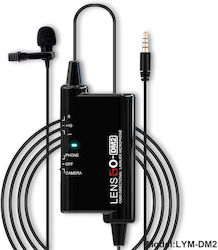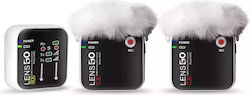
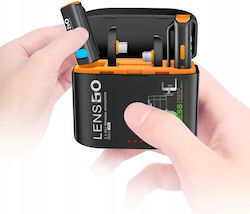
Lapel: Small microphone that is placed on clothing (on the lapel, collar, or shirt). Ideal for interviews, presentations, and television productions, as it is discreet and leaves hands free.
Handheld: Held in hand or placed on a stand. Ideal for singing, interviews, live events, and presentations, offering direct control of the distance from the mouth.
Shock Mounted : Microphone mounted on a special shock-absorbing base that absorbs vibrations and noise. Ideal for recording studios and professional podcasting.
Desktop: Placed on a desk or table. Mainly used for podcasting, streaming, teleconferencing, and radio.
Head: Worn on the head or ear, keeping the microphone close to the mouth. Used in presentations, fitness instructors, theatrical performances, and gaming.
Contact: Similar to the lapel, but can also be attached to musical instruments or other objects. Used for guitars, wind instruments, and hands-free recordings.
Gooseneck: It has a flexible neck that easily adjusts to the speaker's position. Ideal for announcements, conferences, desks, and churches.
USB: Connects directly to a computer, easy to use without external equipment. Ideal for podcasting and streaming, but with lower quality compared to XLR.
XLR: Professional connection with a three-pin cable, offers better sound quality, less noise. Ideal for recording studios and live use.
Bluetooth: Wireless connection, ideal for mobile devices and simple use, but it may have latency and lower sound quality compared to wired connections.
3.5mm: Basic connection used in computers, smartphones, and cameras. It operates easily but may have more noise and lower quality than USB or XLR.
USB Type-C: Improved version of USB, with faster data transfer and compatibility with newer smartphones, tablets, and laptops. Ideal for streaming, podcasting, and portable recordings.
Lightning: Used with Apple devices (iPhone, iPad), offering good sound quality and direct connection without adapters.
6.35mm: It is mainly used in musical instruments, amplifiers, and professional audio. It offers superior quality and durability but requires compatible equipment.
Dynamic: Durable and does not require external power. It withstands high sound levels and is ideal for live performances, singing, and musical instrument amplifiers. It has less sensitivity to details compared to condenser microphones.
Condenser (Large Diaphragm): Captures rich and natural sound, emphasizing low and mid frequencies. Ideal for vocals, podcasting, voice-over, and professional recordings. Requires phantom power and is more sensitive to ambient noise than dynamic microphones.
Condenser (Small Diaphragm): Very sensitive and captures sound details with great precision. Ideal for musical instruments (e.g., acoustic guitars, piano, wind instruments) and studio recordings. Requires external power supply (+48V phantom power).
Unidirectional (Cardioid): (Cardioid): Captures sound primarily from the front, reducing sounds from the sides and rear. Ideal for vocals, podcasting, and live recordings.
Omnidirectional: (Omnidirectional): Captures sound equally from all directions. Ideal for environmental recordings, interviews, and natural sound.
Shotgun: Single directional microphone with increased forward response. It is suitable for stages, television or film sets, as well as recording from a distance.
Type (Directionality): It refers to the directions from which the microphone picks up sound and how sensitive it is at each angle. It affects the recording quality and noise isolation.