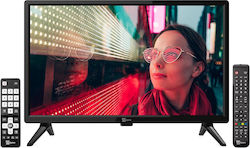
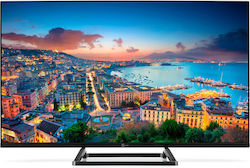
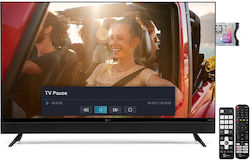
Smart TV: Ability to browse the internet and/or use online applications.
Android TV: It has an Android operating system with access to the Google Play Store.
HDMI 2.1: Newer HDMI standard, necessary for utilizing features (such as 120Hz) offered by the new Sony PlayStation 5 & Microsoft Xbox Series X|S consoles.
Satellite Receiver: Integrated satellite receiver. A satellite dish is required.
Airplay: AirPlay allows wireless transmission of images, audio, and video from Apple devices to compatible TVs.
HbbTV: Ability to integrate online services (such as ERTflix, Mega Plus, SKAI Hybrid, and Open Hybrid) into the TV program through the terrestrial TV antenna.
Screen Casting: Wirelessly display your mobile or laptop screen on your TV.
NanoCell: Technology that reproduces true colors by applying 1 nm nanoparticles. In 8K resolution, NanoCell TV delivers picture quality similar to OLEDs, with improved color fidelity.
OLED: Perfect black performance, incredibly natural images and great color accuracy.
QLED: They offer a wider range of colors and higher maximum brightness compared to LED and OLED.
Mini LED: Uses tiny LEDs for more precise and localized lighting. Offers better contrast, deeper blacks, and reduced "blooming" effect. It is an upgrade over standard LED, with performance close to OLED.
Neo QLED: Development of QLEDs using mini-LEDs (smaller and more LEDs) in the backlight, approaching OLEDs in black performance.
QNED: QNED combines Quantum Dot, NanoCell, and Mini LED for more vivid colors and better contrast.
LED: Limited performance capability of black, greater maximum brightness compared to OLEDs.
Full HD: Resolution 1920x1080 pixels, suitable for smaller TVs (up to 43") and everyday use such as TV channels, streaming in 1080p, and gaming without high demands.
4K Ultra HD: Resolution 3840x2160 pixels, ideal for medium and large screens (43"-65"+), offers a clearer picture with detail - perfect for 4K streaming, next-generation gaming, and high-resolution movies.
8K Ultra HD: Resolution 7680x4320 pixels, suitable for very large screens (65"+), mainly for future use or professional environments, as 8K content is still limited but offers exceptional clarity.
HDR10+: Smarter HDR than standard HDR10. Adjusts brightness and color according to the scene for a more natural and dynamic picture.
Dolby Vision: It offers much more accurate colors, higher brightness, and smoother transitions, even in very dark or bright scenes.
VRR: A TV with VRR (Variable Refresh Rate) can adjust the refresh rate in real-time to match the frequency of the signal source, such as PC, Xbox One, Xbox S/X, and PlayStation 5.
HDR: Basic HDR system. Offers better brightness and contrast compared to simple SDR, with consistent performance throughout the image.
Local Dimming: Technology of LED TVs for better black performance and color contrast.
AI Upscaling: Transforms lower resolution videos into clearer and closer to 4K or 8K, with intelligent detail enhancement.
AI Picture: The TV recognizes what is being shown (e.g., faces, landscapes, action) and automatically enhances the picture for a more realistic result.
HLG: HDR for live television and live content. Ideal for sports and news, with enhanced brightness and color without complex settings.
HDR10 Pro: A variation of HDR10, with additional real-time processing and enhancements through AI.
New energy efficiency scale consisting of classes A to G. Devices with class A (green) have the lowest energy consumption, while devices with class G (red) have the highest consumption.