I have had this specific hard drive (Toshiba P300 HDWD110UZSVA) for a little over a month now. Obviously, it is too early to form any accurate opinion about its stability and reliability. On the day I received it, I properly installed it in the case (an old budget Cougar from 2015), disconnected the SSD, and immediately installed Windows 10 to see how it performs as the main drive and to run some tests simultaneously, mainly to check if it is defective and to get a first impression of its reliability.
One of these tests was CrystalDiskMark 8, where the speeds were more than satisfactory for an HDD. Specifically, it managed to reach up to 200MB/s Read and 195MB/s Write (SEQ1MQ8T1) in the first benchmark I ran, while using only 4% of its capacity.
Here I should mention and clarify that it is perfectly reasonable for an HDD to have noticeably slower boot times compared to almost any SSD (the Samsung 870 EVO I have had for a year initially powered on in 20-23" with fast startup disabled, now it takes around 30", and the Toshiba took about 40" to reach the desktop, also with fast startup disabled, but you have to wait a few seconds for it to stabilize). Overall, the system was quite responsive and applications opened relatively quickly for this type of drive. I was not disappointed with its performance as the main drive, although a SATA SSD, let alone an NVMe, is clearly more suitable, no doubt about it.
The next day, after leaving the Toshiba running continuously for over 15 hours during which I ran several benchmarks, I booted from the Samsung and wiped the Toshiba using the "clean all" command in diskpart (which essentially destroys the disk's files by writing 0s and 1s to each sector of the disk and takes quite some time). It started the process with Write speeds of 190-200MB/s, and just before it finished, the speed had dropped to 110MB/s. In other words, it wrote continuously at a speed of 110+MB/s for about two hours, and its temperature did not exceed 36°C! That is truly impressive for a mechanical drive.
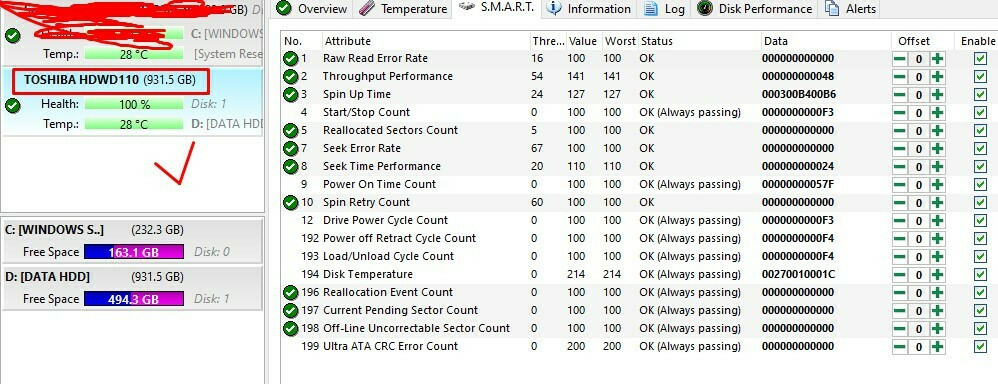
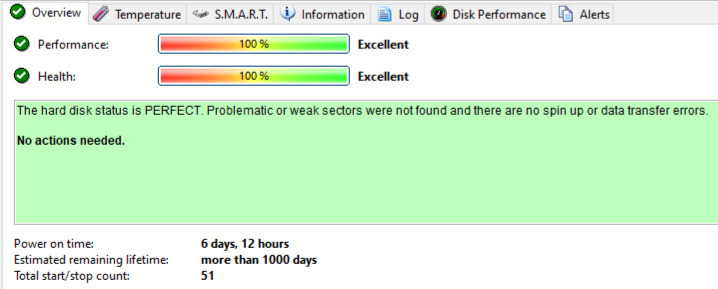
After going through all of that without any issues, it is obviously not DOA and gave me the impression that it has the potential to prove reliable over time, which is why I trusted it with my files.
Since then, I have been using it as a secondary storage drive, mainly for storing files such as photos and videos, and I have run dozens of benchmarks and tests in general.
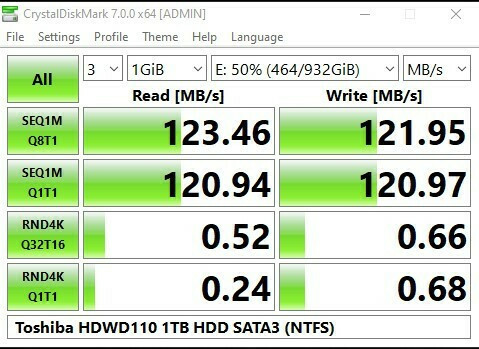
The speeds have now decreased significantly (120-130MB/s Read & Write) because I am using almost half of the capacity (43%). Completely normal.
It is slightly noisy, but I discovered this when I turned on the PC with the Toshiba disconnected and recorded the case's sound both with and without the drive in operation to confirm it. Even in the recording, the difference is negligible. Even under load, it does not make more or less noise compared to idle, unless you literally put your ear on the drive, then you can hear a faint hum. Additionally, the motor makes a minimal noise during startup and a noticeable click when it "parks" during shutdown, but nothing worrisome.
Regarding temperature, at room temperature, without cooling, it has never exceeded 36°C (as mentioned before, it stayed at that temperature for at least 2 hours continuously when I reset it, and since then it hasn't gotten any hotter).
So far, I am completely satisfied in every aspect. Fast, almost silent, low temperatures, and reliable for now.
My humble system:
Motherboard: Gigabyte GA-H110M-S2
CPU: Intel Pentium G4400
GPU: Intel HD Graphics 510
RAM: 12GB [8GB Corsair DDR4 3000Mhz + 4GB DDR4 2400Mhz (the processor supports up to 2133Mhz)]
Main Disk (SSD): Samsung 870 EVO 500GB
That's all from me, I know I wrote quite a bit, I don't want to become tiresome. I will come back in the future.
P.S. The Toshiba P300 HDWD110UZSVA is CMR technology and has a similar, if not the same, architecture as Hitachi, so there is a high chance it will withstand the test of time.
Έχω τον συγκεκριμένο σκληρό δίσκο (Toshiba P300 HDWD110UZSVA) εδώ και λίγο παραπάνω από έναν μήνα. Προφανώς είναι πολύ νωρίς για να σχηματιστεί η οποιαδήποτε ορθή άποψη για τη σταθερότητα και την αξιοπιστία του. Τη μέρα που τον παρέλαβα τον τοποθέτησα σωστά στο κουτί (ένα παλιό budget Cougar του 2015), αποσύνδεσα τον SSD και αμέσως του εγκατέστησα Windows 10 για να δω πώς τα πάει ως κύριος δίσκος αλλά και για να κάνω κάποιες δοκιμές ταυτόχρονα, πιο πολύ για να ελέγξω μια και καλή αν είναι ελαττωματικός αλλά και κατά κάποιον τρόπο να έχω μια πρώτη εικόνα για την αξιοπιστία του.
Μία απ' τις δοκιμές αυτές ήταν το CrystalDiskMark 8, όπου οι ταχύτητες ήταν παραπάνω από ικανοποιητικές για HDD. Συγκεκριμένα, κατάφερε να πιάσει μέχρι και 200MB/s Read και 195MB/s Write (SEQ1MQ8T1) στο πρώτο benchmark που του έτρεξα, ενώ χρησιμοποιούσε μόνο το 4% της χωρητικότητάς του.
Εδώ να πω και να ξεκαθαρίσω ότι είναι απολύτως λογικό ένας HDD να έχει αισθητά πιο αργά boot times από σχεδόν οποιονδήποτε SSD (ο Samsung 870 EVO που έχω εδώ και 1 χρόνο, στην αρχή έκανε power on σε 20-23" με απενεργοποιημένο το fast startup, τώρα έχει ανέβει ο χρόνος στα 30" και ο Toshiba έμπαινε στην επιφάνεια εργασίας σε περίπου 40", επίσης με απενεργοποιημένο το fast startup, αλλά πρέπει να περιμένεις κάποια δευτερόλεπτα να στρώσει). Σε γενικές γραμμές, το σύστημα ήταν αρκετά ανταποκρίσιμο και οι εφαρμογές άνοιγαν σχετικά γρήγορα για το είδος του. Δεν έμεινα και απογοητευμένος με τις επιδόσεις του ως κύριος δίσκος, αν και ένας SATA SSD, πόσω μάλλον ένας NVMe είναι σαφώς πιο κατάλληλος δεν το συζητάμε καν.
Την επόμενη μέρα, αφού είχα αφήσει τον Toshiba να λειτουργεί συνεχόμενα για παραπάνω από 15 ώρες, στη διάρκεια των οποίων είχα τρέξει αρκετά benchmarks, έκανα boot από τον Samsung και έκανα wipe τον Toshiba με την εντολή "clean all" στο diskpart (η οποία περιληπτικά καταστρέφει τα αρχεία του δίσκου, γράφοντας 0 και 1 σε κάθε sector του δίσκου και παίρνει αρκετή ώρα). Ξεκίνησε τη διαδικασία με ταχύτητες Write 190-200MB/s και λίγο πριν τελειώσει, η ταχύτητα είχε πέσει στα 110MB/s. Δηλαδή έγραφε για περίπου δύο ώρες συνεχόμενα με ταχύτητα 110+MB/s και η θερμοκρασία του δεν ξεπέρασε τους 36°C! Αυτό κι αν είναι εντυπωσιακό για μηχανικό δίσκο.
Αφού τα πέρασε όλα αυτά χωρίς κανένα πρόβλημα, προφανώς δεν είναι DOA & μου έδωσε την εντύπωση ότι έχει πιθανότητες να αποδειχθεί αξιόπιστος σε βάθος χρόνου, γι' αυτό του εμπιστεύτηκα τα αρχεία μου.
Από τότε τον χρησιμοποιώ ως δεύτερο δίσκο για αποθήκευση αρχείων, κυρίως φωτογραφίες και βίντεο και έχω τρέξει δεκάδες benchmarks και tests γενικότερα.
Πλέον οι ταχύτητες έχουν πέσει αρκετά (120-130MB/s Read & Write), επειδή χρησιμοποιώ σχεδόν τον μισό χώρο (43%). Απολύτως φυσιολογικό.
Είναι ελάχιστα θορυβώδης, αλλά αυτό το ανακάλυψα όταν ενεργοποίησα το pc με τον Toshiba αποσυνδεδεμένο και ηχογράφησα το κουτί μία όταν ήταν και μία όταν δεν ήταν ο δίσκος σε λειτουργία για να το επιβεβαιώσω. Μέχρι και στην ηχογράφηση, η διαφορά είναι αμελητέα πραγματικά. Ακόμη και under load δεν κάνει ούτε περισσότερο ούτε λιγότερο θόρυβο σε σχέση με idle, εκτός αν κυριολεκτικά ακουμπήσεις το αυτί σου στον δίσκο, τότε ακούγεται ένα αμυδρό χρχρ. Επίσης, το μοτέρ κάνει έναν μηδαμινό θόρυβο κατά την εκκίνηση και ένα αισθητό κλικ η κεφαλή όταν "παρκάρει" κατά την απενεργοποίηση, τίποτα ανησυχητικό πάντως.
Όσον αφορά τη θερμοκρασία, σε θερμοκρασία δωματίου, χωρίς cooling, δεν έχει ξεπεράσει ποτέ τους 36°C (όπως προανέφερα, έγραφε για τουλάχιστον 2 ώρες συνεχόμενα όταν τον έκανα reset και από τότε δεν έχει ζεσταθεί περισσότερο).
Μέχρι στιγμής είμαι απόλυτα ικανοποιημένος από κάθε άποψη. Γρήγορος, σχεδόν αθόρυβος, χαμηλές θερμοκρασίες και αξιόπιστος προς το παρόν.
Το ταπεινό σύστημά μου:
Motherboard: Gigabyte GA-H110M-S2
CPU: Intel Pentium G4400
GPU: Intel HD Graphics 510
RAM: 12GB [8GB Corsair DDR4 3000Mhz + 4GB DDR4 2400Mhz (ο επεξεργαστής ούτως ή άλλως υποστηρίζει μέχρι και 2133Mhz)]
Main Disk (SSD): Samsung 870 EVO 500GB
Αυτά από μένα, ξέρω έγραψα αρκετά, δεν θέλω να γίνομαι κουραστικός. Θα επανέλθω στο μέλλον.
Υ.Γ. Ο Toshiba P300 HDWD110UZSVA είναι τεχνολογίας CMR και έχει αρχιτεκτονική παρόμοια, αν όχι ίδια με αυτή της Hitachi, επομένως υπάρχει μεγάλη πιθανότητα να αντέξει σε βάθος χρόνου.