13
00
€
Delivery
by Mon, 24 Aug
14,00 €
shipping cost
Sent from Greece
Set the delivery location to see products according to your choice.
Top specs
 Number of pages
372
Number of pages
372
 Cover
Soft
Cover
Soft
 Year of publication
2002
Year of publication
2002
 Publisher
Ekdoseis Kaktos
Publisher
Ekdoseis Kaktos
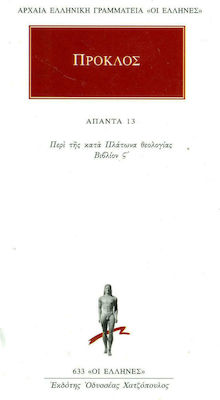
The gods of the world (the transcendental, the twelve transcendental-cosmic, the cosmic, the universal souls, the higher kinds). Proclus, one of the last great thinkers of Neoplatonic philosophy and ancient Greek philosophical thought in general, was born in Constantinople on February 8, 412 AD. Born into a wealthy family from Lycia, he studied in the best educational centers of his time, Alexandria, Constantinople, Athens.
There he came into contact with the Athenian Neoplatonic Academy, which captured him definitively and of which he became the director after the death of his teacher, Syrianus. He died in Athens on April 17, 485 AD and was buried near Lykabettus.
Living in an era of syncretic chaos, he would synthesize into a single and complex system the entire preceding Neoplatonic philosophical tradition, influenced by Pythagorean, Aristotelian, and Stoic elements; in his system he would gather the one god, the intelligible and the intellectual substances, magic, and various demonic beings, and in this form he would hand it over to the scholastic Middle Ages.
His work is a fundamental source for every student of Neoplatonic philosophy, as well as for Plato himself, whose original and extremely interesting interpretations he often proposes.
[Excerpt from the publisher's or edition's presentation text]
Specifications are collected from official manufacturer websites. Please verify the specifications before proceeding with your final purchase. If you notice any problem you can report it here.
