It was purchased in October 2021 (212 euros) to replace a Toshiba 4Tb (HDWE140UZSVA) as online storage for the desktop because I needed more space and didn't want to have a second 4Tb HDD.
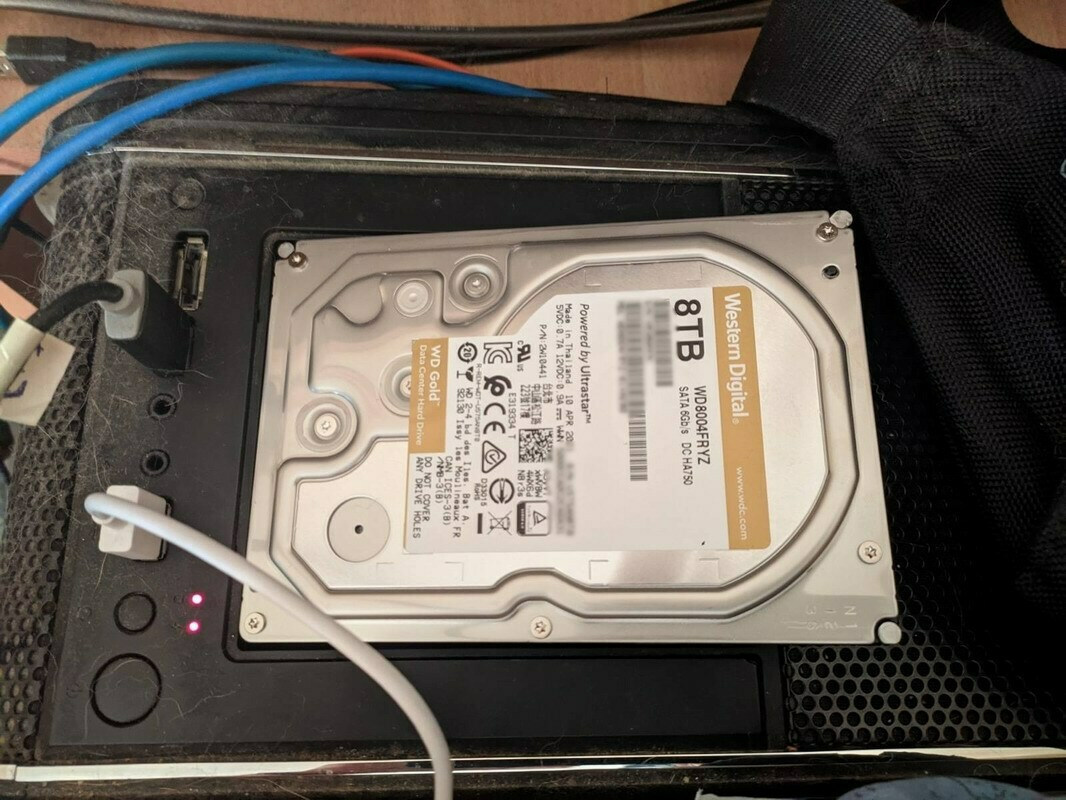
Bulk packaging as usual, it was opened and connected - as I always do with new hard drives - externally to my old Coolermaster CM690 II Advanced case (as shown in the photo).
As always, as soon as it was connected, my hand was on it to see if it had booted from the vibrations. When I didn't feel anything, I thought, OK, after 30+ years of experience with hard drives, this is the first DOA. A visit to Disk Management proved that the disk had booted and was spinning/working normally. So, first shock for me, it's the first HDD out of the dozens I have purchased that has ZERO vibrations.
Second shock, the noise. I had read various things on the internet about these drives, and after a year with a Toshiba X300 4TB, I was skeptical (which for me was on the verge of annoying). I don't know if mine is the exception, but I don't hear anything when it's idle (it doesn't "whisper") and a little when it's reading, and I am extremely sensitive to such noises. When it's idle (just spinning), personally I can compare it to an internal 2.5" disk that spins at 5400rpm. When it's reading, there are slight "clicking" sounds, and when it's writing, it sounds normal, but for me, it's not excessive (obviously, this is subjective, but it can be heard).
After a standard format (NTFS) in Windows, the disk showed a total available capacity of 7.27Tb.
As with all new drives, I ran HDD Sentinel Surface Test (Read) before starting to write data, and the disk was flawless with no bad or weak sectors.
Now, in practice, it's slightly less "warm" than the Toshiba X300 4Tb, not that there's an issue with the latter, it's just that none of them are as "cool" as my WD Blue 4Tb drives (which is logical, 5400 vs 7200rpm).
In terms of speed in the HDD Sentinel Surface Test (Read, we're talking about 7.5 to 11 hours in a row depending on the disk), the WD Gold 8Tb (WD8004FRYZ) started at 250MB/s and finished at 120Mb/s. Comparatively, my Toshiba X300 4Tb drives start at 190Mb/s and finish at 80-85Mb/s, while my WD Blue 4Tb drives (WD40EZRZ) start at 170-180Mb/s and finish at 78-80Mb/s. All of these are purely indicative, in practice it's different. So far, with my usage, the Gold seems slightly faster than my Toshiba drives, but as I said, that's with my usage. As specifications and on paper, it's significantly faster everywhere.
For further observations, reliability, etc., I will update over time. The drive has a 5-year warranty and I registered it on the WD website on the same day I received it.
UPDATE 6/1/2022: After 3 months of full usage, I must admit that for my usage at least, the Gold is indeed significantly faster in write and especially in read for any type of files compared to my Toshiba drives.
Αγοράστηκε τον Οκτώβριο του 2021 (212 ευρω) για να αντικαταστήσει εναν Toshiba 4Tb (HDWE140UZSVA) ως online storage για το desktop γιατι χρειαζόμουν περισσότερο χώρο και δεν ήθελα να έχω και 2ο HDD των 4Tb.
Bulk συσκευασία ως συνήθως, ανοιχτηκε και συνδέθηκε - οπως κανω παντα με καινουριους σκληρους δίσκους - εξωτερικα στο παλιό μου Coolermaster CM690 II Advanced κουτί (όπως φαίνεται στην φωτογραφία).
Οπως πάντα με το που συνδέθηκε το ένα χερι μου ήταν επάνω του για να καταλαβω οτι έχει κανει boot απο τους κραδασμους. Οταν δεν ένιωσα τιποτα σκεφτηκα, ΟΚ, μετά απο 30+ χρόνια εμπειρίας με σκληρους δισκους, αυτός ειναι ο πρώτος DOA. Μια επισκεψη στο Disk Management απεδειξε οτι ο δίσκος ειχε μπουτάρει και σπιναρε/δουλευε κανονικότατα. Πρωτο σοκ λοιπον για μένα, είναι ο πρώτος HDD απο τους 10άδες που έχω αγοράσει που έχει ΜΗΔΕΝ κραδασμους.
Δευτερο σοκ, ο θορυβος. Ειχα διαβάσει διάφορα στο ιντερνετ για τους συγκεκριμένους και μετά απο έναν χρόνο με έναν Toshiba X300 4TB ήμουν επιφυλακτικός (που για μένα ήταν στο όριο του ενοχλητικου). Δεν ξέρω αν ο δικός μου είναι η εξαίρεση αλλα δεν ακούω τιποτα oταν είναι idle (δεν "σφυριζει") και λίγο όταν κάνει read και είμαι εξαιρετικά ευαισθητος σε τετοιου τυπου θορυβους. Όταν είναι idle (απλά spinάρει) προσωπικά μπορω να τον συγκρίνω με εσωτερικό 2.5" δισκο που γυρναει στις 5400rpms. Όταν διαβάζει διαβάζει ακούγονται ελαφρια "χτυπηματάκια" ενώ όταν γράφει ακούγεται κανονικότατα αλλά για μένα δεν είναι κάτι υπερβολικό (προφανώς είναι υποκειμενικό και αυτο, αλλά ακουγεται πάντως).
O δισκος μετά απο standard format (NTFS) σε Win, έδειξε συνολική διαθεσιμη χωρητικότητα 7,27Tb.
Οπως και με όλους τους καινουριους δισκους, ετσι και σε αυτόν έτρεξα HDD Sentinel Surface Test (Read) πριν αρχίσω να γραφω data, ο δισκός ήταν αψογος χωρις bad ή weak sectors.
Τωρα, στην πράξη είναι λίγο λιγότερο "ζεστός" από τους Toshiba X300 4Tb, όχι οτι με τους τελευταίους υπάρχει θέμα, απλά κανείς απο αυτους δεν είναι όσο "κρύοι" είναι οι WD Blue 4Tb μου (λογικο, 5400 vs 7200rpms).
Σε ταχύτητα στο HDD Sentinel Surface Test (Read, μιλάμε για 7.5 με 11 ώρες σερί αναλόγως με τον δίσκο) ο WD Gold 8Tb (WD8004FRYZ) ξεκίνησε απο τα 250ΜΒ/s και τελείωσε στα 120Mb/s. Συγκριτικά, οι Toshiba X300 4Tb μου ξεκινάνε απο τα 190Mb/s και τελειώνουν στα 80-85Mb/s ενώ οι WD Blue 4Tb μου (WD40EZRZ) ξεκινάνε 170-180Μb/s και τελειώνουν στα 78-80Μb/s. Όλα αυτά τελειως ενδεικτικα, στην πράξη πάει διαφορετικά. Μέχρι στιγμής με την δικια μου χρήση ο Gold φαινεται λίγο πιο γρήγορος απο τoυς Toshiba μου, αλλά είπαμε, με την δικά μου χρήση. Σαν προδιαγραφές και στα χαρτιά είναι αρκετα ταχυτερος παντού.
Για περαιτερω παρατηρήσεις, αξιοπιστία κοκ, θα κάνω update με τον καιρό, ο δισκος εχει 5 χρονια εγγυηση και τον έκανα register την ίδια ημέρα που τον παρέλαβα στο site της WD.
UPDATE 6/1/2022: τελικά μετά από 3 μηνες φουλ χρήσης ομολογώ οτι για την δική μου χρήση τουλάχιστον, ο Gold είναι όντως σημαντικά πιο γρήγορος στο write αλλα ειδικα στο read σε οποιουδήποτε τυπου αρχεία σε σχέση με τους Toshiba μου.