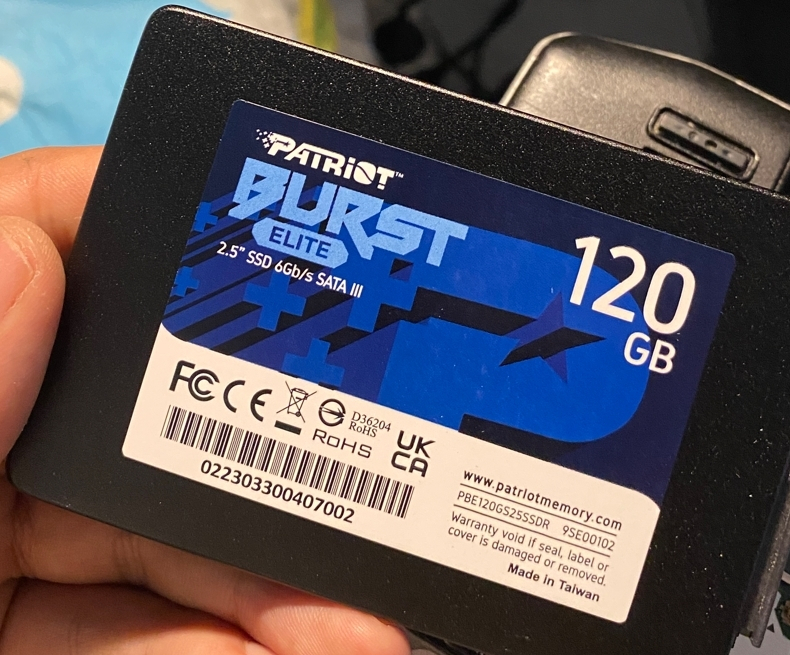
This particular SSD came to me randomly installed in a refurbished laptop with relatively good specs (i5, 8GB RAM). I opened the laptop to apply new thermal paste to the CPU and I am reviewing it now since I saw it and it is the first Patriot hard drive I have.
It is an SSD with very good performance compared to old mechanical HDDs, as expected, but compared to more expensive and higher quality SSDs, it is lower in performance (especially with small and random files) and reliability, i.e., for erase-write TBW, Patriot gives 50TBW (very likely TLC for the 128GB, for larger capacities possibly QLC).
In SSDs, memory technologies like TLC (cheap, less durable), MLC (expensive, fast, durable), 3D NAND (cheap, fast, reliable, between TLC-MLC), SLC (very expensive, very fast, very durable), etc., are used.
Of course, for basic use in an old PC that had an HDD, it is a big upgrade in boot speed and overall user experience at a very low cost (about 10€), making it a value-for-money purchase.
Let's go into detail:
- Many mention having problems with this SSD, and from what I understand, with some Phison controllers or bad batches, where in this low price category there are many chances of failure.
Mine, which I opened and saw the chips, has two TLC memories and uses the Silicon Motion SM2259XT 28nm, 32-bit 1 core @ 437 MHz controller (in this price category, as expected, it does not have DRAM as a buffer or for uniform write management across all the NAND cells, which more expensive SSDs have for longevity), but it has a kind of pseudo-SLC memory of 32MB with smart algorithms that 'do' the above process in combination with the main RAM of the PC. The SM2259XT controller, from what I see on Google, is also common in other low-end SSDs, even in cheap 960GB SSD models.
- In terms of endurance, the manufacturer promises 50 TBW with TLC or QLC technology (in the worst case), as expected, and even if it reaches half that TBW, it will be perfect, since I have in one system a Samsung 840 Pro 128GB, which has worked intensively for 9 years, has done 42.37 TBW so far with a limit of 73 TBW with MLC technology and has started to lag, with 84% health.
How reliable it is will show over time, since so far it is at 0.57 TBW and 100% health.
- In terms of speeds, we have very good results, of course with small and random files there is a drop as expected. In a recent measurement on the 9-year-old, heavily used Samsung 840 Pro, the cheap Patriot surpassed it by about 100 MB/s in the SEQ1M Q8T1 and Q1T1 tests, while in random and small RND files, the 840 Pro, due to its DRAM and 3-core controller, surpassed it by 20 MB/s more.
On the SATA III interface, where the limit is 600 MB/s, you have a comfortable and fast experience in the operating system and daily applications, and in game setups they load quickly with a SATA SSD compared to SATA HDD magnetic disks.
If you have laptops or PCs with an M.2 NVME interface, prefer NVME SSDs, as the M.2 NVME interface reaches speeds of GB/s, and you will see a big difference only in processing large 4K video files running from an NVME disk, and also no cables for better cable management.
Patriot Burst Elite 120GB:
Read SEQ1M Q8T1: 561.11 MB/s, Write SEQ1M Q8T1: 489.19 MB/s
Read SEQ1M Q1T1: 515.82 MB/s, Write SEQ1M Q1T1: 430.17 MB/s
Read RND4K Q32T1: 147.85 MB/s, Write RND4K Q32T1: 134.84 MB/s
*Test CrystalMark / 3 @ 1GB of sample
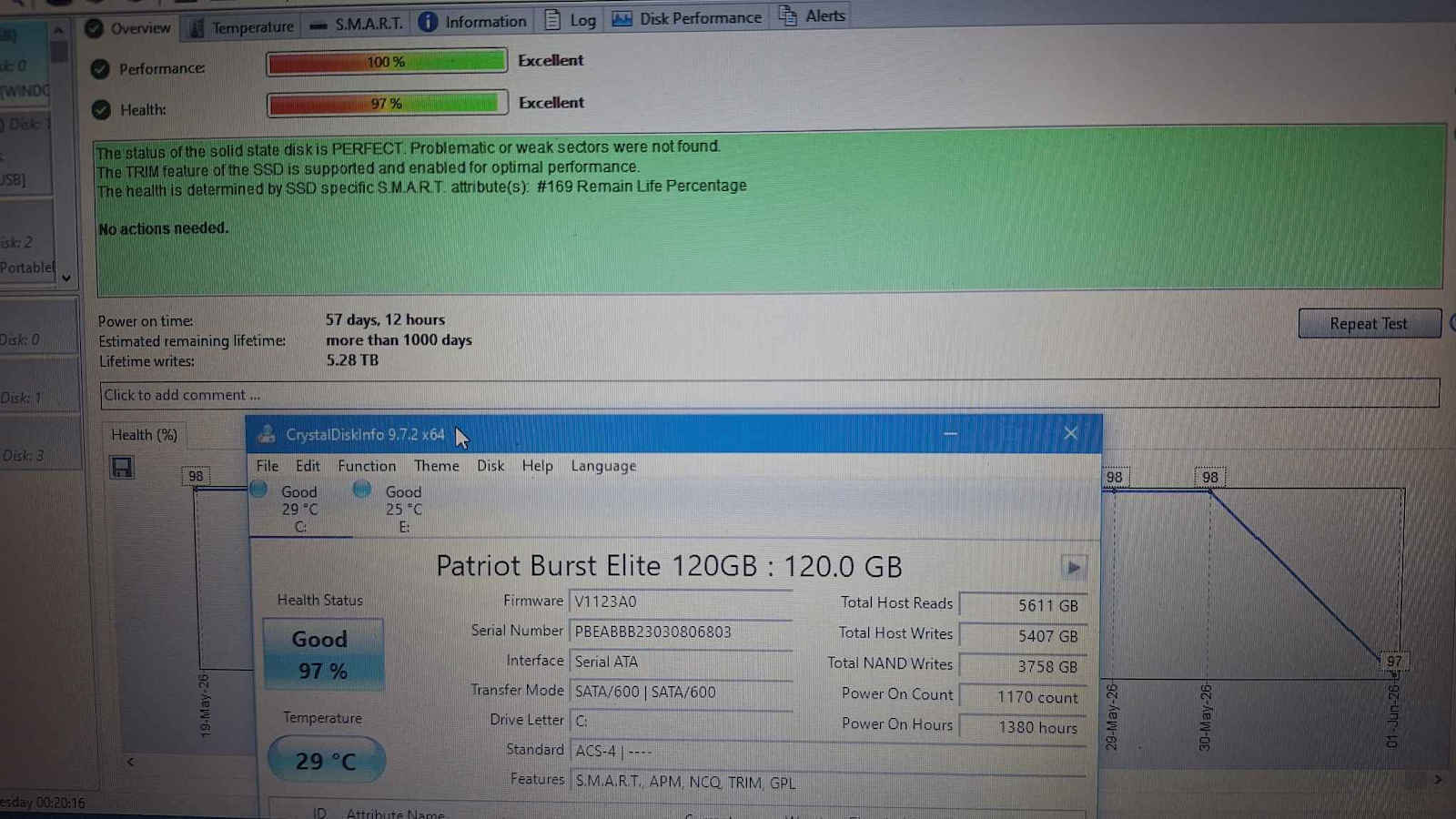
Update from January to May 2026 (98% health at 5.1 TBW)
Update 2 June 2026 (97% health at 5407GB writes, and 3758GB NAND writes).
Ο συγκεκριμένος SSD μου ήρθε τυχαία εγκατεστημένος σε refurbished laptop με καλά σχετικά χαρακτηριστικά (i5, 8gb ram), άνοιξα το laptop για να περάσω νέα θερμο-αγώγιμη πάστα στην cpu και το αξιολογώ τώρα μιας και τον είδα και αποτελεί τον πρώτο Patriot σκληρό δίσκο που έχω.
Είναι ένας SSD με πολύ καλές επιδόσεις σε σχέση με τους παλιούς μηχανικούς σκληρούς δίσκους HDD όπως είναι αναμενόμενο,
αλλά σε σχέση με ακριβούς και ποιοτικότερους SSD είναι χαμηλότερων επιδόσεων (περισσότερο στα μικρά και τυχαία αρχεία) και αξιοπιστίας δηλαδή στα σβήσε-γράψε TBW η Patriot δίνει 50TBW (πολύ πιθανόν TLC για τα 128gb για μεγαλύτερες χωρητικότητες πιθανόν QLC ),
στους SSD οι τεχνολογίες μνήμης TLC (φθηνό, λιγότερη αντοχή ), MLC (ακριβό, γρήγορο, αντοχής), 3D NAND (φθηνό, γρήγορο, ανάμεσα σε TLC-MLC αξιόπιστο, SLC πολύ ακριβό, πολύ γρήγορο πολύ αντοχή) κ.α
βέβαια για βασική χρήση σε ένα παλιό Η/Υ που φόραγε HDD είναι μια μεγάλη αναβάθμιση στην ταχύτητα εκκίνησης και γενικά στην εμπειρία χρήσης με πολύ χαμηλό κόστος (περίπου 10Ε) φαίνεται μια συμφέρουσα Value For Money αγορά.
Πάμε αναλυτικά
- Πολλοί αναφέρουν ότι έχουν προβλήματα με το συγκεκριμένο SSD και από ότι κατάλαβα με κάποιους controller της Phison ή κακές παρτίδες όπου σε αυτήν την χαμηλή κατηγορία τιμής υπάρχουν πολλές πιθανότητες αστοχίας.
Ο δικός μου που τον άνοιξα και είδα τα chips έχει δυο TLC μνήμες και φοράει τον controller Silicon Motion SM2259XT 28nm, 32-bit 1 core @ 437 MHz (σε αυτήν την κατηγορία τιμής όπως είναι λογικό δεν διαθέτει DRAM ως buffer αλλά και ως διαχείριση του ομοιόμορφου write σε όλα τα NAND κελιά του δίσκου που έχουν οι ακριβότεροι SSD για μακροζωία ) αλλά ένα είδος ψευδο-μνήμης SLC των 32ΜΒ με έξυπνους αλγόριθμους που "κάνει" την παραπάνω διαδικασία με συνδυασμό της κύρια μνήμη RAM του Η/Υ. Ο controller SM2259XT από ότι βλέπω στο Google συνηθίζεται και σε άλλους SSD χαμηλής κατηγορίας ακόμα και στα φθηνά SSD μοντέλα των 960 GB.
- Από αντοχή στο σβήσε-γράψε ο δίσκος σύμφωνα με τον κατασκευαστή υπόσχεται 50 TBW με την τεχνολογία TLC ή QLC (στην χειρότερη περίπτωση) όπως είναι αναμενόμενο και τα μισά TBW να φτάσει θα είναι τέλειος μιας και έχω σε ένα σύστημα τον Samsung 840 Pro 128GB ο οποίος έχει δουλέψει εντατικά 9 χρόνια, έχει κάνει ως τώρα 42,37 TBW με όριο τα 73 TBW με τεχνολογία MLC και έχει αρχίσει να κολλάει, με 84% health.
Το πόσο αξιόπιστος είναι θα δείξει με το καιρό, μιας και μέχρι τώρα είναι στα 0,57 TBW και 100% health.
- Από ταχύτητες έχουμε πολύ καλές, βέβαια στα μικρά και τυχαία αρχεία υπάρχει μια πτώση όπως είναι λογικό, σε πρόσφατη μέτρηση στον 9 χρονών ταλαιπωρημένο Samsung 840 Pro, ο φθηνός Patriot τον πέρασε κατά 100 MB/s περίπου στις δοκιμές στο SEQ1M Q8T1 και Q1T1 ενώ στα τυχαία και μικρά αρχεία RND ο 840 Pro λόγω της DRAM και του 3 core controller τον πέρασε κατά 20 MB/s παραπάνω.
Στην διεπάφή SATA ΙΙΙ οπου το όριο είναι τα 600 MB/s έχετε μια άνετη και γρήγορη εμπειρία στο λειτουργικό σύστημα και τις καθημερινές εφαρμογές όπως και στα setups των games φορτώνουν γρήγορα με SATA SSD σε σχέση με τους SATA HDD μαγνητικούς δίσκους .
Αν έχετε laptops οι Η/Υ με διεπαφή M.2 NVME προτιμήστε SSD NVME καθώς η διεπαφή M.2 NVME φτάνει ταχύτητες της τάξης των GB/s, και θα δείτε διαφορά μεγάλη μόνο σε επεξεργασία μεγάλων αρχείων βίντεο 4K που τρέχουν από NVME δίσκο, αλλά και στα καθόλου καλώδια για καλύτερο cable management.
Patriot Burst Elite 120GB
: Read SEQ1M Q8T1 : 561.11 MB/s , Write SEQ1M Q8T1 : 489.19 MB/s
Read SEQ1M Q1T1 : 515.82 MB/s , Write SEQ1M Q1T1 : 430.17 MB/s
Read RND4K Q32T1 : 147.85 MB/s , Write RND4K Q32T1 : 134.84 MB/s
*Test CrystalMark / 3 @ 1GB of sample
Update Απο Ιανουάριος εως Μαιο 2026 (98% health στα 5,1 TBW)
Update 2 Ιουνιου 2026 (97% health στα 5407gb writes, και 3758gb nand writes).