"Thank you, Abbot," said William, "it is my great pleasure to be in your reverence's monastery, whose fame has spread beyond the mountains. I come as a pilgrim in the name of our Lord, and you have honored me as such. But I also come in the name of our earthly ruler, as the letter I hand you will tell you, and on his behalf I thank you for your welcome." The Abbot took the letter with the imperial seals and said that William's arrival had been announced in other letters from his brothers (and then I thought with some pride that it is difficult to surprise a Benedictine abbot); then he asked the storekeeper to lead us to our quarters, while the stablemen took our animals. The Abbot expected to visit us later, when we would be rested, and we entered the large courtyard, where the monastery's buildings extended over the entire peaceful plateau, which softened the summit of the mountain with its hollow—or its flatness.
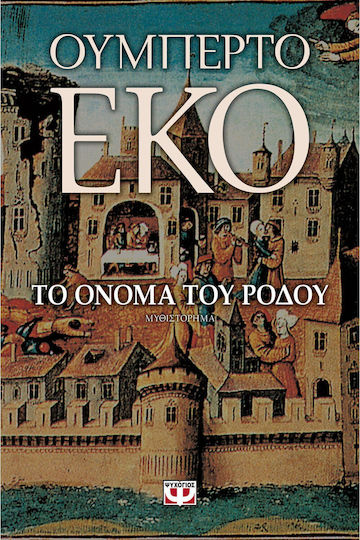
Do you want to do philosophy? Write a novel. This suggestion belongs to Albert Camus, and it seems that this is exactly the path that Umberto Eco decided to follow when, thirty years ago, already established as an academic, thinker, and essayist, he made his first appearance in the realm of fiction with The Name of the Rose.
A work that is both centripetal and centrifugal, made from a heterogeneous raw material that Eco's cheerful mastery manages to creatively assemble. The Name of the Rose continues to captivate us after thirty years, precisely because of this indeterminate form that allows it to exist at the boundaries between the mysterious and the obvious, the hidden and the apparent, the adventurous and the abstract or ideological.
Elliptical because it accumulates particular historical -and not only- knowledge and information, gray because it is full of colors and an unexpected decor, out of date and timeless because it establishes itself in temporal slices and inscribes its police, fast-paced plot within History, Eco's first novel now serves as a reference point for world literature.
[Excerpt from the text on the back cover of the edition]
Read an excerpt
Manufacturer
Product Guides
- Author
- Umberto Eco
- Publisher
- PSychogios
- Original Title
- Il nome della rosa
- Publishers
- Psychogios
- Type
- Classical Literature, Prose
- Subtitle
- Novel
- Cover
- Soft
- Number of Pages
- 724
- Release Date
- 6/2011
- Publication Date
- 2011
- Dimensions
- 14x21 cm
- ISBN-13
- 9789604960729
Important information
Specifications are collected from official manufacturer websites. Please verify the specifications before proceeding with your final purchase. If you notice any problem you can report it here.