Inverters

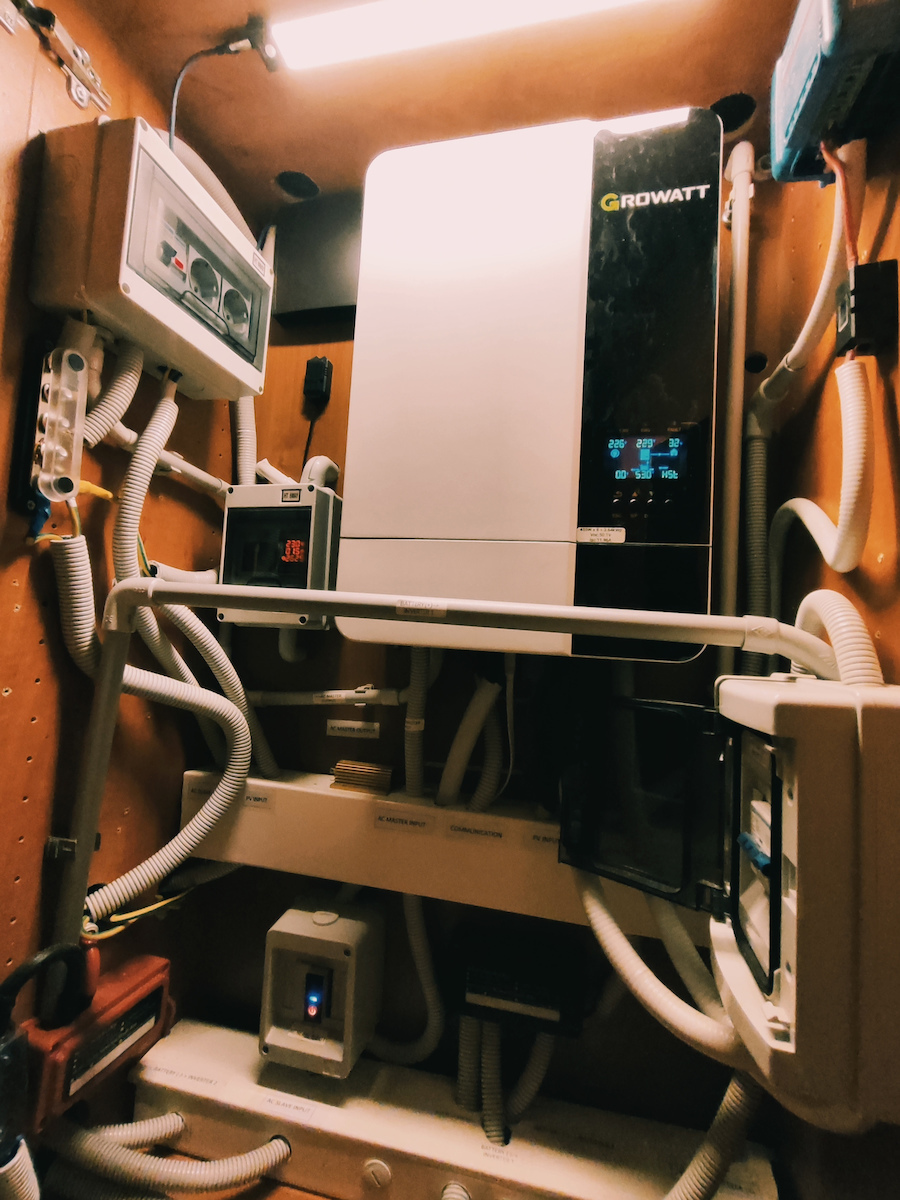
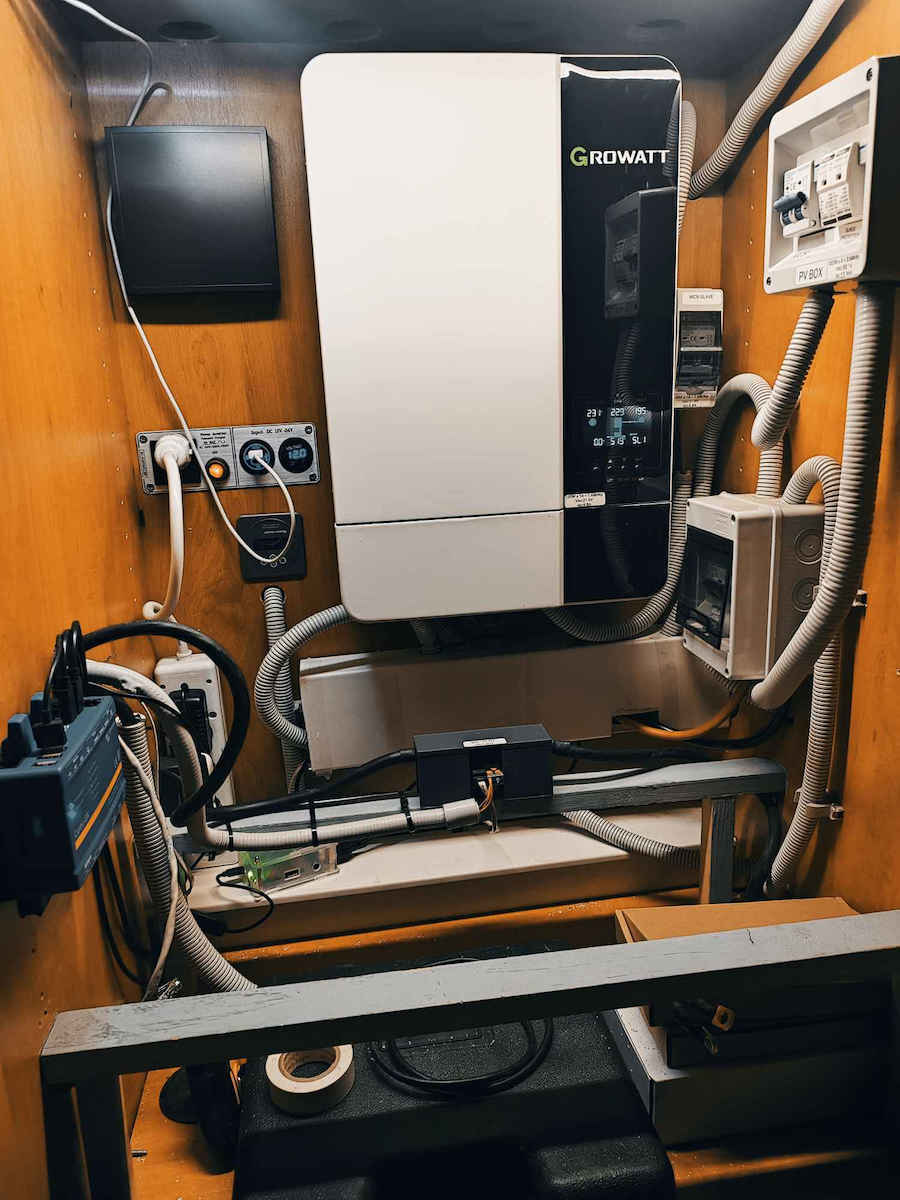
Growatt SPF 3500 ES Pure Sine Wave Power Inverter 3500W with Input Voltage 230V Single Phase SW10146

Single-phase inverter from Growatt with pure sine wave output. It converts direct current (DC) 230V to alternating current (AC) single-phase and allows the supply of devices and electrical...

Single-phase inverter from Growatt with pure sine wave output. It converts direct current (DC) 230V to alternating current (AC) single-phase and allows the supply of devices and electrical networks from renewable energy sources such as photovoltaic systems and wind turbines.
All devices powered by a pure sine wave inverter will operate according to their...

See full description See full description

Description

Description

Single-phase inverter from Growatt with pure sine wave output. It converts direct current (DC) 230V to alternating current (AC) single-phase and allows the supply of devices and electrical networks from renewable energy sources such as photovoltaic systems and wind turbines.
All devices powered by a pure sine wave inverter will operate according to their full specifications.

Manufacturer

See full description

Specifications

Specifications

Type
Pure Sine Wave
Rated power
3500 W
Nominal Input Voltage
230 V
Power supply
Single Phase

Important information

Specifications are collected from official manufacturer websites. Please verify the specifications before proceeding with your final purchase. If you notice any problem you can report it here.

See all specifications

Reviews (10)

Reviews

  1. 7
  2. 4 stars
    0
  3. 3 stars
    0
  4. 1
  5. 2
Review this product

Reviews photos

Reviews photos
Reviews photos
Reviews photos
Reviews photos
Reviews photos
Reviews photos

Reviews by our members

  • ALEX VASILIADIS
    5
    3 out of 3 members found this review helpful
    This review is about the rated power: 6000 W

    So, I have done several installations with this particular product, either on its own or in parallel in the same phase, or in a three-phase system, or even three-phase with a single-phase parallel for more power.
    That is, I have done all the combinations with this specific inverter that it provides in installations.

    The device is very good and its price now, as I write, at 650-700 euros is very good for what it offers.

    If you also combine it with solar assistant, you have a top-notch installation and monitoring data.

    The only negative thing I have to say is that I would like it to have a slightly more stable low cut off. That is, when you have set it to switch to the grid or whatever you have, for example at the battery limit of 20%, it might switch you at about 25%, so there is a deviation there. While you see it has 25%, you say you still have 5% for the battery to burn until it switches you to the grid again, but it might switch you in a second at 20% and realize it needs to switch, while normally the battery might still have more but it did not read it correctly.

    It's a small issue, it only happens at a low percentage, that is, within the 20-30% of the batteries, but apart from that, it's an amazing device. It is definitely worth its money.

    Translated from Greek ·
    Did you find this review helpful?
  • nikos_drakos839
    1
    0 out of 26 members found this review helpful

    Verified purchase

    This review is about the rated power: 6000 W

    It's a flop, it's for throwing away. The manual says one thing, the panel says another, and it does something else. I'm talking about the SPF 6000 ES Plus

    Translated from Greek ·
    Did you find this review helpful?
  • Μπιλάρας
    5
    35 out of 35 members found this review helpful

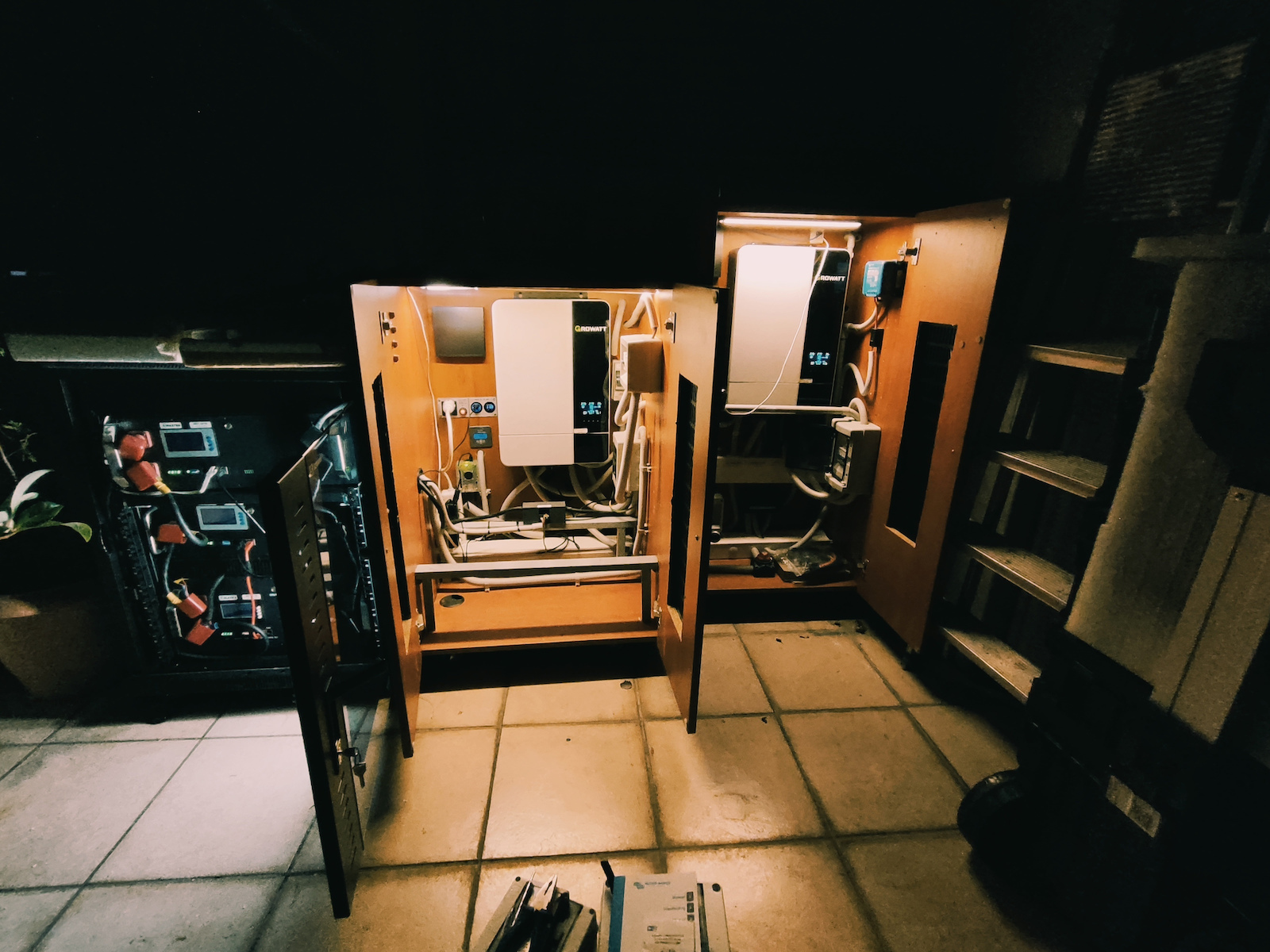
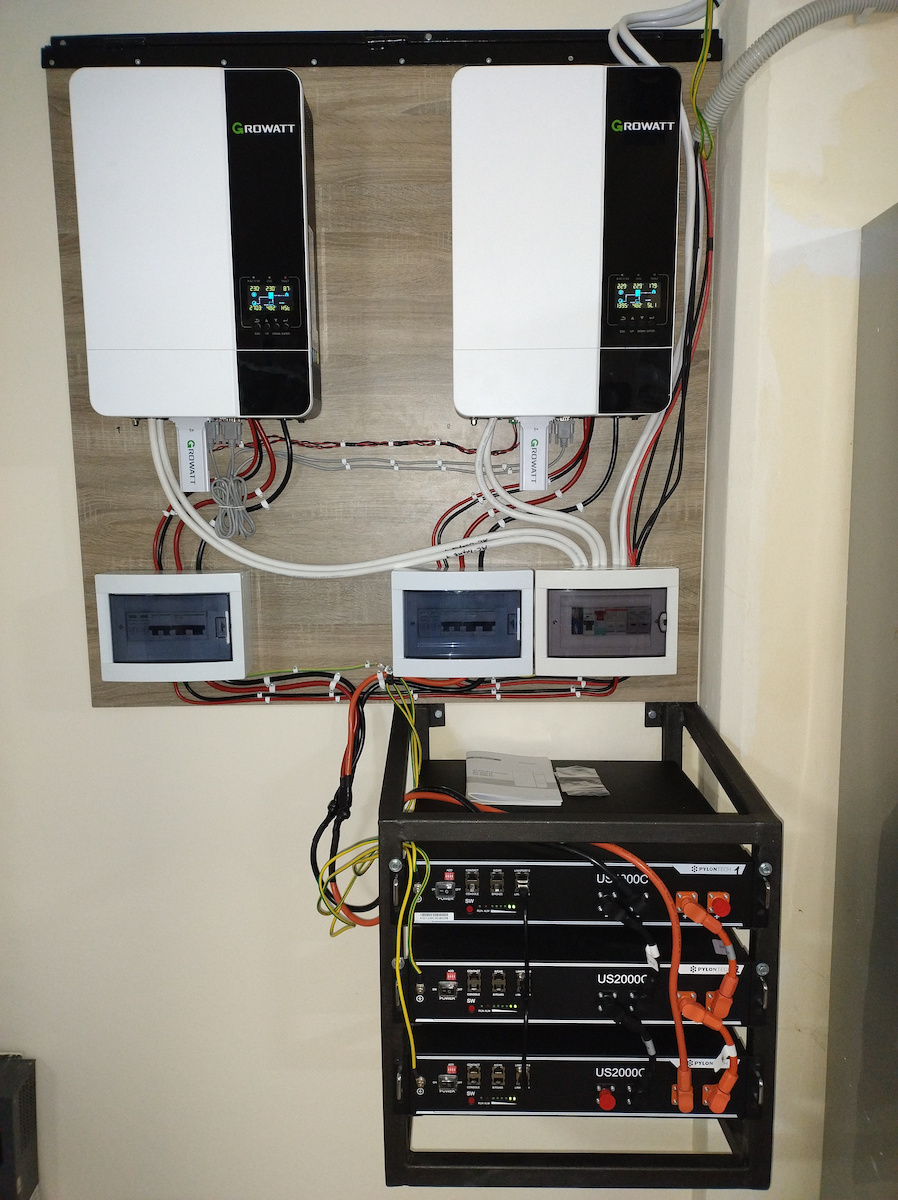
    Two 3500VA inverters (7000VA total) were installed as a replacement for the old system (1 POWMR 5500VA inverter + 1 MPPT charger).

    These inverters are very robust and larger than the previous one they replaced, they appear to be of much higher quality.

    In terms of power, I have seen them operate up to 7800W, which is over 10% above the 7000W they are rated for. The previous 5500W inverter would bypass the grid even at 4000W. So the machines deliver the advertised performance unlike other cheaper options.

    When operating from Battery-Panel, the consumption is only 7W from the grid, which is likely due to the automatic switch I have for the generator. With the old inverter, I consistently saw 30-40W...

    Each of the two has two battery chargers, one AC charger for charging from the grid-generator and one DC MPPT charger for charging from panels. This means that with two inverters, I have two independent panel arrays (one Southeast and the other Southwest).

    Charging from the grid happens automatically if the batteries drop too low, and it charges 1 kilowatt-hour. I have manually charged from the generator (changing some settings) during a storm, charging for 2-3 hours while the generator runs and then drawing from the battery at night until the grid power returns. The previous inverter developed a problem and wouldn’t charge at all from the grid-generator, so I had no way to charge my batteries if there was no sun! (risky for cases of prolonged bad weather-snow)

    The WiFi modules I purchased separately can be a bit of a hassle for someone who doesn’t know much about technology; I expected the connection to be a bit easier. Tip: for location, set it to Cyprus when creating an account because for Greece it asks for a second account from the one that installed it and a lot of bureaucratic processes. The signal is very good! In the basement where the inverters are located, my mobile phone sees the WiFi. You can view the statistics from various platforms and a mobile app, but I use the following: https://server.growatt.com/

    Tips and observations for installing a parallel system (2+ inverters):

    1) The system does not work at all without a battery! The battery is essential because it acts as an intermediary for the cooperation of the two machines, meaning that if the battery needs service, the whole system goes offline. With one inverter, it is possible to operate at least temporarily without a battery.
    2) Since there are two inverters, there will be more idle consumption, and just having the machines running results in some standard consumption, which also causes battery drainage during the night. There is also a bit more noise since you have double the fans running, but you don’t have the system in your living room.
    3) You must carefully read all the instructions for the parallel connection and make all the necessary settings; if you forget something, one error code will come after another accompanied by beeps (I got anxious at some point during the setup).
    4) Once the system becomes parallel, you only change the settings of one (any) and automatically the other changes as well, with the exception of some settings that are separate for each (e.g., some settings for charging limits or settings related to the parallel connection).

    The only problem I encountered is with the communication with my batteries (Pylontech); it is supported, but I couldn't get anything to work while trying to make the two sides communicate. For now, I am operating the batteries with voltage limits (up to where it charges, up to where it discharges, and a minimum limit), and it was a bit of a hassle to find the numbers needed experimentally. If I manage to solve the problem, I will update.

    The machines are Chinese, as are my batteries; this does not mean they are not reliable; there are bad and good Chinese products, and I think China is ahead of everyone in this field. The brand is very important! I would buy these specific machines again.

    Translated from Greek ·
    Did you find this review helpful?
  • Eyaggelos_Strataridakis
    5
    1 out of 1 members found this review helpful
    This review is about the rated power: 6000 W

    It is excellent in everything, top-notch, the only thing is that the data with the wifi on the phone is never said correctly, just this, but I see it from the screen

    Translated from Greek ·
    Did you find this review helpful?
  • Mach_Solven
    1
    19 out of 54 members found this review helpful
    This review is about the rated power: 5000 W

    Stay away for anyone who wants to have Lead batteries. It does not charge them daily as the manufacturers say, 62.4 V and it only gives 58.4 V. You will destroy your batteries as the electrolyte density will gradually decrease as they are not maintained as the Manufacturer says, meaning when the density drops below 1245, then they must be charged for 10 hours with 64.4 V to restore the density to 1240 to 1245. Every month, the level of the liquids and the density must be checked.
    LiFe Lithium Batteries are better in this matter... but they are sensitive, and if even one fails, then the whole rack needs to be replaced.
    P.S. I finally found the solution not to lose the batteries and I share it to help others.
    1) 2V x 24 Batteries = 48 V Bulk Volt = 2.6V/cell, Float Volt = 2.3 V/cell
    2) Monthly, you check the density with the Tool (https://www.skroutz.gr/s/40016122/AMiO-Metritis-Ilektrolyton-Mpatarias.html) It must be 1240-1245... If it approaches the red 1180... IMMEDIATELY Revival Charge = 2.7 V/cell x 24 = 64.8 V!!!
    BUT THIS INVERTER ONLY PROVIDES 58.4 V!!! I contacted the Company and they were trying to justify their mistake, shame on them.
    3) Fortunately, my Son reassured me and said, "Dad... just remove one array of batteries (2 batteries) so it becomes 22 Batteries x 2.7 V = 59.4 V, it's still less, son!"
    4) Dad, we will trick it with a code... you press the two arrows simultaneously and it asks for a code... and you enter 111... press Enter and select menu 030 with the arrows... press Enter and you can change the voltage values... So... while the batteries are 59.4 Volts... you write that they are 1 volt lower, meaning 58.4 volts!!! (note to help) = as you increase the values, the voltage decreases, and as you decrease the values, the voltage increases... it goes backwards... so we increase by one volt and it shows the batteries as 58.4 instead of 59.4...
    5) Another problem solved with this method = I have 2 Inverters in parallel for 10 Kilowatts... BUT one Inverter showed less voltage than the other and thus did not charge the batteries!!!
    So, with the method I mentioned earlier, I adjusted the voltage that each one should display separately so that both Inverters show the same and also less than the batteries so that they charge correctly.
    What can we do? We didn't know before we bought them... they were cheaper and had the possibility of parallel connection and we were convinced by the advertisements... Of course, I don't think Lithium batteries have such a problem because they communicate electronically among themselves (I don't know, maybe there is a problem there too).
    We chose Lead because they don't understand hardships and they are not dangerous, they don't break easily and if one breaks, you can easily replace it... while with Lithium... I saw what cars and others that use Lithium went through. I also saw a video by Kalogerakis and he is amazing and knowledgeable about solar

    Translated from Greek ·
    Did you find this review helpful?
  • orizonclub
    5
    10 out of 10 members found this review helpful

    Verified purchase

    This review is about the rated power: 5000 W

    very reliable machine.

    Translated from Greek ·
    Did you find this review helpful?
  • campingcaravan73
    5
    51 out of 51 members found this review helpful
    This review is about the rated power: 5000 W

    One of the best. It works both with and without batteries. You can connect it to the mains or a generator, and it's the only one that can take all the power from the photovoltaics if you need a lot of wattage, and if you need more at that moment, it can also take it from the grid or battery simultaneously...the others automatically switch to the grid once they pass 5000w, and of course you pay only for the grid. Simple connections, simple program, but if you want to be sure, get someone who knows what they're doing so you don't burn it. It has wifi so you can always see what's happening, how much the photovoltaics are producing, and analysis for each day, week, month, year, and statistics, as well as what each device is consuming. It also has certification for many different reasons. Additionally, if you have many large consumptions, you can install up to 6 of the same in parallel. I believe that 2 are enough for a house to power all devices together.

    Translated from Greek ·
    Did you find this review helpful?
  • Pollux
    5
    237 out of 237 members found this review helpful
    This review is about the rated power: 5000 W

    Very good all-in-one Inverter.
    This particular model is classified as a so-called hybrid off-grid system, which means it is completely independent from the public electricity grid and does not interfere to send power back to the grid. On the contrary, you connect it to a socket or the house panel and it can keep devices running even when the supply from the photovoltaic panels or the battery is insufficient.
    Initially, the inverter works even without the use of a battery. Therefore, if someone does not have the budget to purchase batteries due to cost, they can take advantage of sunny days and cover part of the required energy. The rest is covered by the local grid, so it is as if you are helping through the inverter to cover the required energy from the PV panels and not draw the entire load from the grid.
    This particular inverter can withstand a continuous load of 5kw, so it can support any device or devices simultaneously, as long as we do not exceed 5kw. For this reason, if we want unlimited freedom in what we turn on and when without worrying about tripping the relay, we can install 2 such inverters in parallel (10kw total power), which would allow us to operate at the same time a water heater (4kw), oven (3.5kw), coffee makers (1.5kw), kettles (1.8kw), air conditioner (1.0kw), TV (0.2kw), etc., without any limitation (up to 10kw peak, of course).
    There are 4 types of priority in the way the inverter operates:
    1. Solar First (in this setting, all demand is covered by the PV panel, then by the battery or both in case of insufficient PV, and finally by the grid if the battery cannot cover the need. In this setting, the grid is activated when there is no PV power or battery reserve. So practically, when it gets dark, the grid is activated in this setting and priority is not given to the battery. This setting is good for those who do not have a battery.
    2. Utility First (in this setting, all demand is covered by the grid and only if there is not enough grid supply will the panels and battery be activated. This setting is the most useless since the inverter operates like a simple UPS. This setting is usually used in cases where we are not interested in self-production, we just want a backup system to protect us from grid power outages. That is, like having a huge UPS.
    3. SBU Priority (solar/battery/Utility): In this case, as in the first, priority is given to the PV panel, then the battery is activated, and the grid is activated ONLY when the battery is insufficient or falls below the discharge limits we have set. This setting is ideal for those who have a battery.
    4. SUB Priority (solar/utility/battery). Here, priority is given to the panels, but the battery is activated only if there is no PV availability and no grid. Here the inverter also works as a partial UPS. This setting is mainly used by those who want to keep their batteries as intact as possible, making minimal use of charging/discharging (of course, here arises the question, why did we buy them if we don't use them)...
    There is also the possibility of connecting via WIFI and you can monitor the status of the photovoltaic installation through your mobile phone (ShinePhone application), as well as via computer from the corresponding server (https://server.growatt.com/login).
    Alternatively, it can be connected via USB cable to a Raspberry Pi, and by using a new software that was recently released (called solar assistant), you can have the most up-to-date and automated monitoring environment for all the indicators of the inverter and battery in real-time. This particular software pulls information such as inverter/battery temperatures, and a host of other hidden parameters, allowing you to set up automations, etc.
    Regarding the installation of the inverter, it is very simple:
    First of all, there are 2 ports for AC input/AC output.
    A. On the AC input, you connect the inverter to a socket (or directly to the panel) of the house so you have the ability to power the house from the grid as I mentioned above (at night for example when you have no PV supply and have also run out of battery). As shown in the wiring diagram, the AC inputs from each inverter are connected with 4mm2 cable and end up at a 40A circuit breaker. The output of the circuit breaker goes to the house panel with a 6mm2 cable.
    B. The AC output is the supply coming out of the inverter and powering the household devices. Here, we run a cable (external line and bring it inside the house to connect your devices). The inverter has a max output of 22A, so with a 4mm2 three-wire cable you are covered. If in the future you expand the system by connecting a second inverter in parallel, you go up to 44A, so it's good to use a 6mm2 cable from the start. In the diagram, the wiring from each inverter (4mm2 cable each) ends up at a 40A leakage relay and then connects to a distribution panel to power your devices.
    C. Input for connection to the PV panels (+/-). In the diagram, the panels are connected in series, where the positive pole of the first panel and the negative pole of the last panel are connected to the main switch (PV switch) so you can isolate the panels for inspection/maintenance, then they are connected to a surge protector (SPD) and a 15A circuit breaker (MCB). Be careful that the circuit breaker is DC rated and not AC (the electric arc created by DC is much stronger compared to AC and that's why the construction of disconnectors is different for DC).
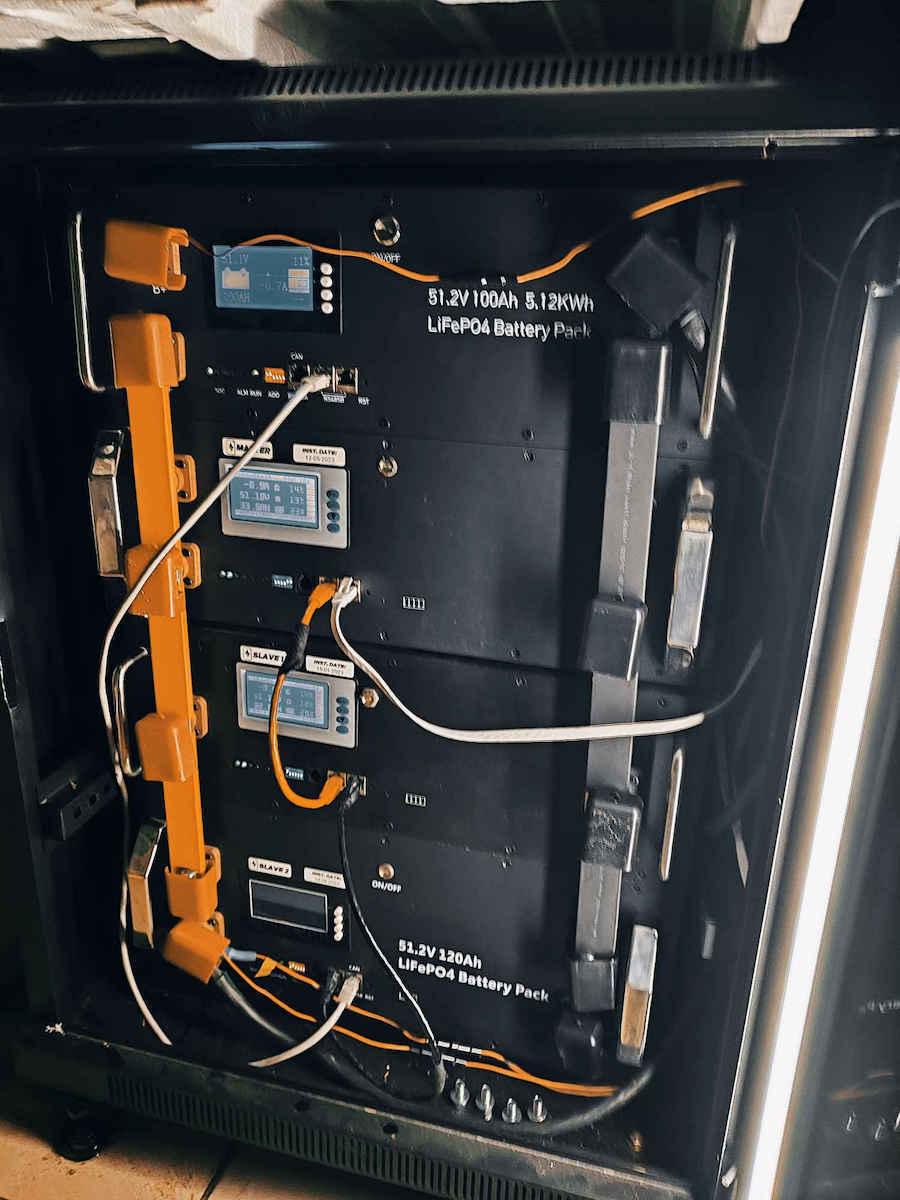
    D. Input for battery connection (+/-). The inverter accepts AGM (deep cycle) batteries, lithium (LiFePO4) with built-in BMS, or lithium without BMS. The cables coming from the battery should be at least 50mm2 to cover the total requirement (in case we have 2 inverters in parallel, otherwise 35mm2 cable is fine). Specifically, for a 5000w inverter at 48v, the current drawn from the battery reaches 105A DC. Therefore, a fuse of at least 125-150A per inverter is required. Also, the battery should be at least 120Ah so that its maximum discharge is about 0.8C, otherwise you risk burning the inverter. The manufacturer recommends a 200Ah battery for one inverter and 400Ah if two are connected in parallel. The fuse should be connected as close as possible to the battery.
    Each cable leaving the battery must end up at a bus-bar (one that collects the positive loads and another for the negative loads). From the positive and negative bus-bars, cables go either to the inverter or to other charge controllers (see diagram).
    Attention, the output from the bus-bars that will end up at the battery needs to have a cable that can withstand the total load of all the loads that end up at the bus-bar (see diagram).
    The connection of the battery fuse I mentioned above is made on the positive pole side, while on the negative pole side you should insert a switch so you can isolate the battery in case of maintenance.

    For your information, the inverter has a setting so you can charge the battery from the public grid at specific times of the day (e.g., using nighttime electricity) in case of cloudy weather. It is not cost-effective, do not do it.
    Also, note that if you connect 2 inverters in parallel, then the use of the battery is mandatory (unlike using only one inverter), otherwise the system does not work. As I said above, in this case it is good for the battery capacity to be at least 400Ah.
    Update after 2.5 years of operation: The system works perfectly, 10kw inverters, 4kw panels, 65kwh LifePO4 batteries.

    Translated from Greek ·
    Did you find this review helpful?
  • 5
    3 out of 3 members found this review helpful

    Verified purchase

    This review is about the rated power: 5000 W

    Reliable inverter, I bought two and I am very satisfied

    Translated from Greek ·
    Did you find this review helpful?
  • This review is about the rated power: 5000 W

  • So, I have done several installations with this particular product, either on its own or in parallel in the same phase, or in a three-phase system, or even three-phase with a single-phase parallel for more power.
    That is, I have done all the combinations with this specific inverter that it provides in installations.

    The device is very good and its price now, as I write, at 650-700 euros is very good for what it offers.

    If you also combine it with solar assistant, you have a top-notch installation and monitoring data.

    The only negative thing I have to say is that I would like it to have a slightly more stable low cut off. That is, when you have set it to switch to the grid or whatever you have, for example at the battery limit of 20%, it might switch you at about 25%, so there is a deviation there. While you see it has 25%, you say you still have 5% for the battery to burn until it switches you to the grid again, but it might switch you in a second at 20% and realize it needs to switch, while normally the battery might still have more but it did not read it correctly.

    It's a small issue, it only happens at a low percentage, that is, within the 20-30% of the batteries, but apart from that, it's an amazing device. It is definitely worth its money.

    Translated from Greek ·
    3
  • It's a flop, it's for throwing away. The manual says one thing, the panel says another, and it does something else. I'm talking about the SPF 6000 ES Plus

    Translated from Greek ·
    0
  • Two 3500VA inverters (7000VA total) were installed as a replacement for the old system (1 POWMR 5500VA inverter + 1 MPPT charger).

    These inverters are very robust and larger than the previous one they replaced, they appear to be of much higher quality.

    In terms of power, I have seen them operate up to 7800W, which is over 10% above the 7000W they are rated for. The previous 5500W inverter would bypass the grid even at 4000W. So the machines deliver the advertised performance unlike other cheaper options.

    When operating from Battery-Panel, the consumption is only 7W from the grid, which is likely due to the automatic switch I have for the generator. With the old inverter, I consistently saw 30-40W...

    Each of the two has two battery chargers, one AC charger for charging from the grid-generator and one DC MPPT charger for charging from panels. This means that with two inverters, I have two independent panel arrays (one Southeast and the other Southwest).

    Charging from the grid happens automatically if the batteries drop too low, and it charges 1 kilowatt-hour. I have manually charged from the generator (changing some settings) during a storm, charging for 2-3 hours while the generator runs and then drawing from the battery at night until the grid power returns. The previous inverter developed a problem and wouldn’t charge at all from the grid-generator, so I had no way to charge my batteries if there was no sun! (risky for cases of prolonged bad weather-snow)

    The WiFi modules I purchased separately can be a bit of a hassle for someone who doesn’t know much about technology; I expected the connection to be a bit easier. Tip: for location, set it to Cyprus when creating an account because for Greece it asks for a second account from the one that installed it and a lot of bureaucratic processes. The signal is very good! In the basement where the inverters are located, my mobile phone sees the WiFi. You can view the statistics from various platforms and a mobile app, but I use the following: https://server.growatt.com/

    Tips and observations for installing a parallel system (2+ inverters):

    1) The system does not work at all without a battery! The battery is essential because it acts as an intermediary for the cooperation of the two machines, meaning that if the battery needs service, the whole system goes offline. With one inverter, it is possible to operate at least temporarily without a battery.
    2) Since there are two inverters, there will be more idle consumption, and just having the machines running results in some standard consumption, which also causes battery drainage during the night. There is also a bit more noise since you have double the fans running, but you don’t have the system in your living room.
    3) You must carefully read all the instructions for the parallel connection and make all the necessary settings; if you forget something, one error code will come after another accompanied by beeps (I got anxious at some point during the setup).
    4) Once the system becomes parallel, you only change the settings of one (any) and automatically the other changes as well, with the exception of some settings that are separate for each (e.g., some settings for charging limits or settings related to the parallel connection).

    The only problem I encountered is with the communication with my batteries (Pylontech); it is supported, but I couldn't get anything to work while trying to make the two sides communicate. For now, I am operating the batteries with voltage limits (up to where it charges, up to where it discharges, and a minimum limit), and it was a bit of a hassle to find the numbers needed experimentally. If I manage to solve the problem, I will update.

    The machines are Chinese, as are my batteries; this does not mean they are not reliable; there are bad and good Chinese products, and I think China is ahead of everyone in this field. The brand is very important! I would buy these specific machines again.

    Translated from Greek ·
    35
  • It is excellent in everything, top-notch, the only thing is that the data with the wifi on the phone is never said correctly, just this, but I see it from the screen

    Translated from Greek ·
    1
  • Stay away for anyone who wants to have Lead batteries. It does not charge them daily as the manufacturers say, 62.4 V and it only gives 58.4 V. You will destroy your batteries as the electrolyte density will gradually decrease as they are not maintained as the Manufacturer says, meaning when the density drops below 1245, then they must be charged for 10 hours with 64.4 V to restore the density to 1240 to 1245. Every month, the level of the liquids and the density must be checked.
    LiFe Lithium Batteries are better in this matter... but they are sensitive, and if even one fails, then the whole rack needs to be replaced.
    P.S. I finally found the solution not to lose the batteries and I share it to help others.
    1) 2V x 24 Batteries = 48 V Bulk Volt = 2.6V/cell, Float Volt = 2.3 V/cell
    2) Monthly, you check the density with the Tool (https://www.skroutz.gr/s/40016122/AMiO-Metritis-Ilektrolyton-Mpatarias.html) It must be 1240-1245... If it approaches the red 1180... IMMEDIATELY Revival Charge = 2.7 V/cell x 24 = 64.8 V!!!
    BUT THIS INVERTER ONLY PROVIDES 58.4 V!!! I contacted the Company and they were trying to justify their mistake, shame on them.
    3) Fortunately, my Son reassured me and said, "Dad... just remove one array of batteries (2 batteries) so it becomes 22 Batteries x 2.7 V = 59.4 V, it's still less, son!"
    4) Dad, we will trick it with a code... you press the two arrows simultaneously and it asks for a code... and you enter 111... press Enter and select menu 030 with the arrows... press Enter and you can change the voltage values... So... while the batteries are 59.4 Volts... you write that they are 1 volt lower, meaning 58.4 volts!!! (note to help) = as you increase the values, the voltage decreases, and as you decrease the values, the voltage increases... it goes backwards... so we increase by one volt and it shows the batteries as 58.4 instead of 59.4...
    5) Another problem solved with this method = I have 2 Inverters in parallel for 10 Kilowatts... BUT one Inverter showed less voltage than the other and thus did not charge the batteries!!!
    So, with the method I mentioned earlier, I adjusted the voltage that each one should display separately so that both Inverters show the same and also less than the batteries so that they charge correctly.
    What can we do? We didn't know before we bought them... they were cheaper and had the possibility of parallel connection and we were convinced by the advertisements... Of course, I don't think Lithium batteries have such a problem because they communicate electronically among themselves (I don't know, maybe there is a problem there too).
    We chose Lead because they don't understand hardships and they are not dangerous, they don't break easily and if one breaks, you can easily replace it... while with Lithium... I saw what cars and others that use Lithium went through. I also saw a video by Kalogerakis and he is amazing and knowledgeable about solar

    Translated from Greek ·
    19
  • See all

Description & Specifications

Single-phase inverter from Growatt with pure sine wave output. It converts direct current (DC) 230V to alternating current (AC) single-phase and allows the supply of devices and electrical networks from renewable energy sources such as photovoltaic systems and wind turbines.
All devices powered by a pure sine wave inverter will operate according to their full specifications.

Manufacturer

Type
Pure Sine Wave
Rated power
3500 W
Nominal Input Voltage
230 V
Power supply
Single Phase

Important information

Specifications are collected from official manufacturer websites. Please verify the specifications before proceeding with your final purchase. If you notice any problem you can report it here.

Reviews (10)

  1. 7
  2. 4 stars
    0
  3. 3 stars
    0
  4. 1
  5. 2
Review this product

Reviews photos

Reviews photos
Reviews photos
Reviews photos
Reviews photos
Reviews photos
Reviews photos

Reviews by our members

  • ALEX VASILIADIS
    5
    3 out of 3 members found this review helpful
    This review is about the rated power: 6000 W

    So, I have done several installations with this particular product, either on its own or in parallel in the same phase, or in a three-phase system, or even three-phase with a single-phase parallel for more power.
    That is, I have done all the combinations with this specific inverter that it provides in installations.

    The device is very good and its price now, as I write, at 650-700 euros is very good for what it offers.

    If you also combine it with solar assistant, you have a top-notch installation and monitoring data.

    The only negative thing I have to say is that I would like it to have a slightly more stable low cut off. That is, when you have set it to switch to the grid or whatever you have, for example at the battery limit of 20%, it might switch you at about 25%, so there is a deviation there. While you see it has 25%, you say you still have 5% for the battery to burn until it switches you to the grid again, but it might switch you in a second at 20% and realize it needs to switch, while normally the battery might still have more but it did not read it correctly.

    It's a small issue, it only happens at a low percentage, that is, within the 20-30% of the batteries, but apart from that, it's an amazing device. It is definitely worth its money.

    Translated from Greek ·
    Did you find this review helpful?
  • nikos_drakos839
    1
    0 out of 26 members found this review helpful

    Verified purchase

    This review is about the rated power: 6000 W

    It's a flop, it's for throwing away. The manual says one thing, the panel says another, and it does something else. I'm talking about the SPF 6000 ES Plus

    Translated from Greek ·
    Did you find this review helpful?
  • Μπιλάρας
    5
    35 out of 35 members found this review helpful

    Two 3500VA inverters (7000VA total) were installed as a replacement for the old system (1 POWMR 5500VA inverter + 1 MPPT charger).

    These inverters are very robust and larger than the previous one they replaced, they appear to be of much higher quality.

    In terms of power, I have seen them operate up to 7800W, which is over 10% above the 7000W they are rated for. The previous 5500W inverter would bypass the grid even at 4000W. So the machines deliver the advertised performance unlike other cheaper options.

    When operating from Battery-Panel, the consumption is only 7W from the grid, which is likely due to the automatic switch I have for the generator. With the old inverter, I consistently saw 30-40W...

    Each of the two has two battery chargers, one AC charger for charging from the grid-generator and one DC MPPT charger for charging from panels. This means that with two inverters, I have two independent panel arrays (one Southeast and the other Southwest).

    Charging from the grid happens automatically if the batteries drop too low, and it charges 1 kilowatt-hour. I have manually charged from the generator (changing some settings) during a storm, charging for 2-3 hours while the generator runs and then drawing from the battery at night until the grid power returns. The previous inverter developed a problem and wouldn’t charge at all from the grid-generator, so I had no way to charge my batteries if there was no sun! (risky for cases of prolonged bad weather-snow)

    The WiFi modules I purchased separately can be a bit of a hassle for someone who doesn’t know much about technology; I expected the connection to be a bit easier. Tip: for location, set it to Cyprus when creating an account because for Greece it asks for a second account from the one that installed it and a lot of bureaucratic processes. The signal is very good! In the basement where the inverters are located, my mobile phone sees the WiFi. You can view the statistics from various platforms and a mobile app, but I use the following: https://server.growatt.com/

    Tips and observations for installing a parallel system (2+ inverters):

    1) The system does not work at all without a battery! The battery is essential because it acts as an intermediary for the cooperation of the two machines, meaning that if the battery needs service, the whole system goes offline. With one inverter, it is possible to operate at least temporarily without a battery.
    2) Since there are two inverters, there will be more idle consumption, and just having the machines running results in some standard consumption, which also causes battery drainage during the night. There is also a bit more noise since you have double the fans running, but you don’t have the system in your living room.
    3) You must carefully read all the instructions for the parallel connection and make all the necessary settings; if you forget something, one error code will come after another accompanied by beeps (I got anxious at some point during the setup).
    4) Once the system becomes parallel, you only change the settings of one (any) and automatically the other changes as well, with the exception of some settings that are separate for each (e.g., some settings for charging limits or settings related to the parallel connection).

    The only problem I encountered is with the communication with my batteries (Pylontech); it is supported, but I couldn't get anything to work while trying to make the two sides communicate. For now, I am operating the batteries with voltage limits (up to where it charges, up to where it discharges, and a minimum limit), and it was a bit of a hassle to find the numbers needed experimentally. If I manage to solve the problem, I will update.

    The machines are Chinese, as are my batteries; this does not mean they are not reliable; there are bad and good Chinese products, and I think China is ahead of everyone in this field. The brand is very important! I would buy these specific machines again.

    Translated from Greek ·
    Did you find this review helpful?
  • Eyaggelos_Strataridakis
    5
    1 out of 1 members found this review helpful
    This review is about the rated power: 6000 W

    It is excellent in everything, top-notch, the only thing is that the data with the wifi on the phone is never said correctly, just this, but I see it from the screen

    Translated from Greek ·
    Did you find this review helpful?
  • Mach_Solven
    1
    19 out of 54 members found this review helpful
    This review is about the rated power: 5000 W

    Stay away for anyone who wants to have Lead batteries. It does not charge them daily as the manufacturers say, 62.4 V and it only gives 58.4 V. You will destroy your batteries as the electrolyte density will gradually decrease as they are not maintained as the Manufacturer says, meaning when the density drops below 1245, then they must be charged for 10 hours with 64.4 V to restore the density to 1240 to 1245. Every month, the level of the liquids and the density must be checked.
    LiFe Lithium Batteries are better in this matter... but they are sensitive, and if even one fails, then the whole rack needs to be replaced.
    P.S. I finally found the solution not to lose the batteries and I share it to help others.
    1) 2V x 24 Batteries = 48 V Bulk Volt = 2.6V/cell, Float Volt = 2.3 V/cell
    2) Monthly, you check the density with the Tool (https://www.skroutz.gr/s/40016122/AMiO-Metritis-Ilektrolyton-Mpatarias.html) It must be 1240-1245... If it approaches the red 1180... IMMEDIATELY Revival Charge = 2.7 V/cell x 24 = 64.8 V!!!
    BUT THIS INVERTER ONLY PROVIDES 58.4 V!!! I contacted the Company and they were trying to justify their mistake, shame on them.
    3) Fortunately, my Son reassured me and said, "Dad... just remove one array of batteries (2 batteries) so it becomes 22 Batteries x 2.7 V = 59.4 V, it's still less, son!"
    4) Dad, we will trick it with a code... you press the two arrows simultaneously and it asks for a code... and you enter 111... press Enter and select menu 030 with the arrows... press Enter and you can change the voltage values... So... while the batteries are 59.4 Volts... you write that they are 1 volt lower, meaning 58.4 volts!!! (note to help) = as you increase the values, the voltage decreases, and as you decrease the values, the voltage increases... it goes backwards... so we increase by one volt and it shows the batteries as 58.4 instead of 59.4...
    5) Another problem solved with this method = I have 2 Inverters in parallel for 10 Kilowatts... BUT one Inverter showed less voltage than the other and thus did not charge the batteries!!!
    So, with the method I mentioned earlier, I adjusted the voltage that each one should display separately so that both Inverters show the same and also less than the batteries so that they charge correctly.
    What can we do? We didn't know before we bought them... they were cheaper and had the possibility of parallel connection and we were convinced by the advertisements... Of course, I don't think Lithium batteries have such a problem because they communicate electronically among themselves (I don't know, maybe there is a problem there too).
    We chose Lead because they don't understand hardships and they are not dangerous, they don't break easily and if one breaks, you can easily replace it... while with Lithium... I saw what cars and others that use Lithium went through. I also saw a video by Kalogerakis and he is amazing and knowledgeable about solar

    Translated from Greek ·
    Did you find this review helpful?
  • orizonclub
    5
    10 out of 10 members found this review helpful

    Verified purchase

    This review is about the rated power: 5000 W

    very reliable machine.

    Translated from Greek ·
    Did you find this review helpful?
  • campingcaravan73
    5
    51 out of 51 members found this review helpful
    This review is about the rated power: 5000 W

    One of the best. It works both with and without batteries. You can connect it to the mains or a generator, and it's the only one that can take all the power from the photovoltaics if you need a lot of wattage, and if you need more at that moment, it can also take it from the grid or battery simultaneously...the others automatically switch to the grid once they pass 5000w, and of course you pay only for the grid. Simple connections, simple program, but if you want to be sure, get someone who knows what they're doing so you don't burn it. It has wifi so you can always see what's happening, how much the photovoltaics are producing, and analysis for each day, week, month, year, and statistics, as well as what each device is consuming. It also has certification for many different reasons. Additionally, if you have many large consumptions, you can install up to 6 of the same in parallel. I believe that 2 are enough for a house to power all devices together.

    Translated from Greek ·
    Did you find this review helpful?
  • Pollux
    5
    237 out of 237 members found this review helpful
    This review is about the rated power: 5000 W

    Very good all-in-one Inverter.
    This particular model is classified as a so-called hybrid off-grid system, which means it is completely independent from the public electricity grid and does not interfere to send power back to the grid. On the contrary, you connect it to a socket or the house panel and it can keep devices running even when the supply from the photovoltaic panels or the battery is insufficient.
    Initially, the inverter works even without the use of a battery. Therefore, if someone does not have the budget to purchase batteries due to cost, they can take advantage of sunny days and cover part of the required energy. The rest is covered by the local grid, so it is as if you are helping through the inverter to cover the required energy from the PV panels and not draw the entire load from the grid.
    This particular inverter can withstand a continuous load of 5kw, so it can support any device or devices simultaneously, as long as we do not exceed 5kw. For this reason, if we want unlimited freedom in what we turn on and when without worrying about tripping the relay, we can install 2 such inverters in parallel (10kw total power), which would allow us to operate at the same time a water heater (4kw), oven (3.5kw), coffee makers (1.5kw), kettles (1.8kw), air conditioner (1.0kw), TV (0.2kw), etc., without any limitation (up to 10kw peak, of course).
    There are 4 types of priority in the way the inverter operates:
    1. Solar First (in this setting, all demand is covered by the PV panel, then by the battery or both in case of insufficient PV, and finally by the grid if the battery cannot cover the need. In this setting, the grid is activated when there is no PV power or battery reserve. So practically, when it gets dark, the grid is activated in this setting and priority is not given to the battery. This setting is good for those who do not have a battery.
    2. Utility First (in this setting, all demand is covered by the grid and only if there is not enough grid supply will the panels and battery be activated. This setting is the most useless since the inverter operates like a simple UPS. This setting is usually used in cases where we are not interested in self-production, we just want a backup system to protect us from grid power outages. That is, like having a huge UPS.
    3. SBU Priority (solar/battery/Utility): In this case, as in the first, priority is given to the PV panel, then the battery is activated, and the grid is activated ONLY when the battery is insufficient or falls below the discharge limits we have set. This setting is ideal for those who have a battery.
    4. SUB Priority (solar/utility/battery). Here, priority is given to the panels, but the battery is activated only if there is no PV availability and no grid. Here the inverter also works as a partial UPS. This setting is mainly used by those who want to keep their batteries as intact as possible, making minimal use of charging/discharging (of course, here arises the question, why did we buy them if we don't use them)...
    There is also the possibility of connecting via WIFI and you can monitor the status of the photovoltaic installation through your mobile phone (ShinePhone application), as well as via computer from the corresponding server (https://server.growatt.com/login).
    Alternatively, it can be connected via USB cable to a Raspberry Pi, and by using a new software that was recently released (called solar assistant), you can have the most up-to-date and automated monitoring environment for all the indicators of the inverter and battery in real-time. This particular software pulls information such as inverter/battery temperatures, and a host of other hidden parameters, allowing you to set up automations, etc.
    Regarding the installation of the inverter, it is very simple:
    First of all, there are 2 ports for AC input/AC output.
    A. On the AC input, you connect the inverter to a socket (or directly to the panel) of the house so you have the ability to power the house from the grid as I mentioned above (at night for example when you have no PV supply and have also run out of battery). As shown in the wiring diagram, the AC inputs from each inverter are connected with 4mm2 cable and end up at a 40A circuit breaker. The output of the circuit breaker goes to the house panel with a 6mm2 cable.
    B. The AC output is the supply coming out of the inverter and powering the household devices. Here, we run a cable (external line and bring it inside the house to connect your devices). The inverter has a max output of 22A, so with a 4mm2 three-wire cable you are covered. If in the future you expand the system by connecting a second inverter in parallel, you go up to 44A, so it's good to use a 6mm2 cable from the start. In the diagram, the wiring from each inverter (4mm2 cable each) ends up at a 40A leakage relay and then connects to a distribution panel to power your devices.
    C. Input for connection to the PV panels (+/-). In the diagram, the panels are connected in series, where the positive pole of the first panel and the negative pole of the last panel are connected to the main switch (PV switch) so you can isolate the panels for inspection/maintenance, then they are connected to a surge protector (SPD) and a 15A circuit breaker (MCB). Be careful that the circuit breaker is DC rated and not AC (the electric arc created by DC is much stronger compared to AC and that's why the construction of disconnectors is different for DC).
    D. Input for battery connection (+/-). The inverter accepts AGM (deep cycle) batteries, lithium (LiFePO4) with built-in BMS, or lithium without BMS. The cables coming from the battery should be at least 50mm2 to cover the total requirement (in case we have 2 inverters in parallel, otherwise 35mm2 cable is fine). Specifically, for a 5000w inverter at 48v, the current drawn from the battery reaches 105A DC. Therefore, a fuse of at least 125-150A per inverter is required. Also, the battery should be at least 120Ah so that its maximum discharge is about 0.8C, otherwise you risk burning the inverter. The manufacturer recommends a 200Ah battery for one inverter and 400Ah if two are connected in parallel. The fuse should be connected as close as possible to the battery.
    Each cable leaving the battery must end up at a bus-bar (one that collects the positive loads and another for the negative loads). From the positive and negative bus-bars, cables go either to the inverter or to other charge controllers (see diagram).
    Attention, the output from the bus-bars that will end up at the battery needs to have a cable that can withstand the total load of all the loads that end up at the bus-bar (see diagram).
    The connection of the battery fuse I mentioned above is made on the positive pole side, while on the negative pole side you should insert a switch so you can isolate the battery in case of maintenance.

    For your information, the inverter has a setting so you can charge the battery from the public grid at specific times of the day (e.g., using nighttime electricity) in case of cloudy weather. It is not cost-effective, do not do it.
    Also, note that if you connect 2 inverters in parallel, then the use of the battery is mandatory (unlike using only one inverter), otherwise the system does not work. As I said above, in this case it is good for the battery capacity to be at least 400Ah.
    Update after 2.5 years of operation: The system works perfectly, 10kw inverters, 4kw panels, 65kwh LifePO4 batteries.

    Translated from Greek ·
    Did you find this review helpful?
  • 5
    3 out of 3 members found this review helpful

    Verified purchase

    This review is about the rated power: 5000 W

    Reliable inverter, I bought two and I am very satisfied

    Translated from Greek ·
    Did you find this review helpful?
  • This review is about the rated power: 5000 W

  • So, I have done several installations with this particular product, either on its own or in parallel in the same phase, or in a three-phase system, or even three-phase with a single-phase parallel for more power.
    That is, I have done all the combinations with this specific inverter that it provides in installations.

    The device is very good and its price now, as I write, at 650-700 euros is very good for what it offers.

    If you also combine it with solar assistant, you have a top-notch installation and monitoring data.

    The only negative thing I have to say is that I would like it to have a slightly more stable low cut off. That is, when you have set it to switch to the grid or whatever you have, for example at the battery limit of 20%, it might switch you at about 25%, so there is a deviation there. While you see it has 25%, you say you still have 5% for the battery to burn until it switches you to the grid again, but it might switch you in a second at 20% and realize it needs to switch, while normally the battery might still have more but it did not read it correctly.

    It's a small issue, it only happens at a low percentage, that is, within the 20-30% of the batteries, but apart from that, it's an amazing device. It is definitely worth its money.

    Translated from Greek ·
    3
  • It's a flop, it's for throwing away. The manual says one thing, the panel says another, and it does something else. I'm talking about the SPF 6000 ES Plus

    Translated from Greek ·
    0
  • Two 3500VA inverters (7000VA total) were installed as a replacement for the old system (1 POWMR 5500VA inverter + 1 MPPT charger).

    These inverters are very robust and larger than the previous one they replaced, they appear to be of much higher quality.

    In terms of power, I have seen them operate up to 7800W, which is over 10% above the 7000W they are rated for. The previous 5500W inverter would bypass the grid even at 4000W. So the machines deliver the advertised performance unlike other cheaper options.

    When operating from Battery-Panel, the consumption is only 7W from the grid, which is likely due to the automatic switch I have for the generator. With the old inverter, I consistently saw 30-40W...

    Each of the two has two battery chargers, one AC charger for charging from the grid-generator and one DC MPPT charger for charging from panels. This means that with two inverters, I have two independent panel arrays (one Southeast and the other Southwest).

    Charging from the grid happens automatically if the batteries drop too low, and it charges 1 kilowatt-hour. I have manually charged from the generator (changing some settings) during a storm, charging for 2-3 hours while the generator runs and then drawing from the battery at night until the grid power returns. The previous inverter developed a problem and wouldn’t charge at all from the grid-generator, so I had no way to charge my batteries if there was no sun! (risky for cases of prolonged bad weather-snow)

    The WiFi modules I purchased separately can be a bit of a hassle for someone who doesn’t know much about technology; I expected the connection to be a bit easier. Tip: for location, set it to Cyprus when creating an account because for Greece it asks for a second account from the one that installed it and a lot of bureaucratic processes. The signal is very good! In the basement where the inverters are located, my mobile phone sees the WiFi. You can view the statistics from various platforms and a mobile app, but I use the following: https://server.growatt.com/

    Tips and observations for installing a parallel system (2+ inverters):

    1) The system does not work at all without a battery! The battery is essential because it acts as an intermediary for the cooperation of the two machines, meaning that if the battery needs service, the whole system goes offline. With one inverter, it is possible to operate at least temporarily without a battery.
    2) Since there are two inverters, there will be more idle consumption, and just having the machines running results in some standard consumption, which also causes battery drainage during the night. There is also a bit more noise since you have double the fans running, but you don’t have the system in your living room.
    3) You must carefully read all the instructions for the parallel connection and make all the necessary settings; if you forget something, one error code will come after another accompanied by beeps (I got anxious at some point during the setup).
    4) Once the system becomes parallel, you only change the settings of one (any) and automatically the other changes as well, with the exception of some settings that are separate for each (e.g., some settings for charging limits or settings related to the parallel connection).

    The only problem I encountered is with the communication with my batteries (Pylontech); it is supported, but I couldn't get anything to work while trying to make the two sides communicate. For now, I am operating the batteries with voltage limits (up to where it charges, up to where it discharges, and a minimum limit), and it was a bit of a hassle to find the numbers needed experimentally. If I manage to solve the problem, I will update.

    The machines are Chinese, as are my batteries; this does not mean they are not reliable; there are bad and good Chinese products, and I think China is ahead of everyone in this field. The brand is very important! I would buy these specific machines again.

    Translated from Greek ·
    35
  • It is excellent in everything, top-notch, the only thing is that the data with the wifi on the phone is never said correctly, just this, but I see it from the screen

    Translated from Greek ·
    1
  • Stay away for anyone who wants to have Lead batteries. It does not charge them daily as the manufacturers say, 62.4 V and it only gives 58.4 V. You will destroy your batteries as the electrolyte density will gradually decrease as they are not maintained as the Manufacturer says, meaning when the density drops below 1245, then they must be charged for 10 hours with 64.4 V to restore the density to 1240 to 1245. Every month, the level of the liquids and the density must be checked.
    LiFe Lithium Batteries are better in this matter... but they are sensitive, and if even one fails, then the whole rack needs to be replaced.
    P.S. I finally found the solution not to lose the batteries and I share it to help others.
    1) 2V x 24 Batteries = 48 V Bulk Volt = 2.6V/cell, Float Volt = 2.3 V/cell
    2) Monthly, you check the density with the Tool (https://www.skroutz.gr/s/40016122/AMiO-Metritis-Ilektrolyton-Mpatarias.html) It must be 1240-1245... If it approaches the red 1180... IMMEDIATELY Revival Charge = 2.7 V/cell x 24 = 64.8 V!!!
    BUT THIS INVERTER ONLY PROVIDES 58.4 V!!! I contacted the Company and they were trying to justify their mistake, shame on them.
    3) Fortunately, my Son reassured me and said, "Dad... just remove one array of batteries (2 batteries) so it becomes 22 Batteries x 2.7 V = 59.4 V, it's still less, son!"
    4) Dad, we will trick it with a code... you press the two arrows simultaneously and it asks for a code... and you enter 111... press Enter and select menu 030 with the arrows... press Enter and you can change the voltage values... So... while the batteries are 59.4 Volts... you write that they are 1 volt lower, meaning 58.4 volts!!! (note to help) = as you increase the values, the voltage decreases, and as you decrease the values, the voltage increases... it goes backwards... so we increase by one volt and it shows the batteries as 58.4 instead of 59.4...
    5) Another problem solved with this method = I have 2 Inverters in parallel for 10 Kilowatts... BUT one Inverter showed less voltage than the other and thus did not charge the batteries!!!
    So, with the method I mentioned earlier, I adjusted the voltage that each one should display separately so that both Inverters show the same and also less than the batteries so that they charge correctly.
    What can we do? We didn't know before we bought them... they were cheaper and had the possibility of parallel connection and we were convinced by the advertisements... Of course, I don't think Lithium batteries have such a problem because they communicate electronically among themselves (I don't know, maybe there is a problem there too).
    We chose Lead because they don't understand hardships and they are not dangerous, they don't break easily and if one breaks, you can easily replace it... while with Lithium... I saw what cars and others that use Lithium went through. I also saw a video by Kalogerakis and he is amazing and knowledgeable about solar

    Translated from Greek ·
    19
  • See all
890,00 €
44,00 €   shipping cost