- The various forms of collaboration with the occupier (political, economic, armed).
- The deep division caused by the collaboration in Greek society.
- The impunity of collaborators after liberation and the role of the Greek justice system in this.
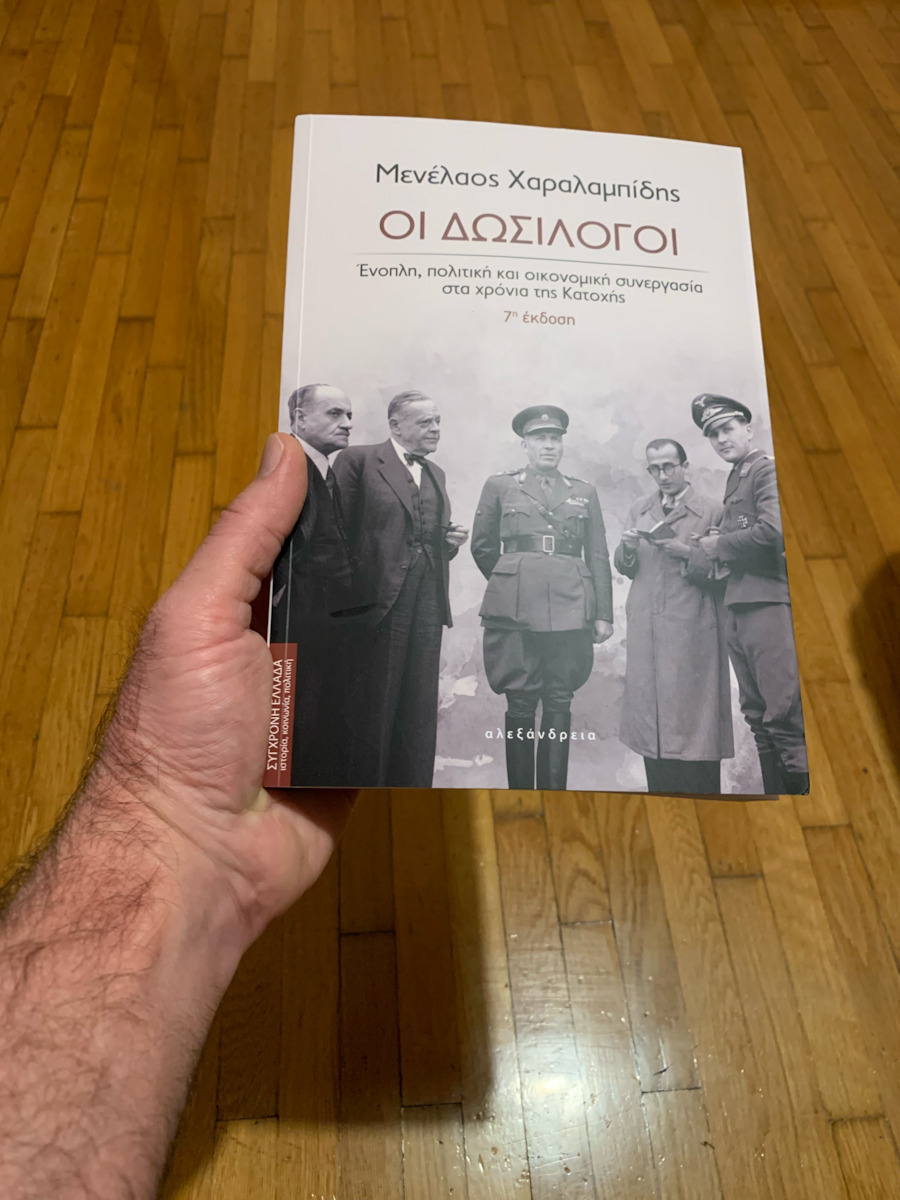
In this book, we follow the political, economic, and armed collaboration with the occupier, as it manifested in the region of Attica. Through the study of archives that are being published for the first time, the actions of those who collaborated are described, the reasons and mechanisms for the development of the collaboration phenomenon are examined, as well as the political and economic conditions that favored its emergence. The policies followed by the three Greek occupation governments, the role of merchants, industrialists, civil engineers, and others in economic transactions with the occupiers, the actions of the Greek Royal Gendarmerie, the Security Battalions, the Greek agents of the SS, and others, who formed the armed wing of the collaboration, and their judicial treatment after the end of the occupation, are at the center of this study.
Collaboration with the occupier characterized everyday life throughout occupied Europe. Politicians, military personnel, businessmen, mayors, judges, priests, journalists, collaborated closely with the occupation authorities, for many different reasons. The initially apparent victory of Germany in the war, anti-communism, the acquisition of quick and easy wealth, ideological alignment with National Socialist Germany and Fascist Italy, the need for survival, were some of them. In Greece, although 80 whole years have passed since the end of the occupation, the issue of collaboration with the occupier continues to be a taboo subject. This is the result of the political oblivion followed by all post-war governments, in their attempt to manage the political consequences of the unprecedented, in intensity and extent, collective trauma caused to Greek society by the collaboration. Collaboration with the occupier was the starting point of the new division, which, with the contribution of other factors, led to the civil conflicts of the occupation, the Dekemvriana, and ultimately to the civil war of the 1940s.
In the book you will meet
- The various forms of collaboration with the occupier (political, economic, armed).
- The deep division caused by the collaboration in Greek society.
- The impunity of collaborators after liberation and the role of the Greek justice system in this.
Why We Loved It
The book sheds light on a dark aspect of the Occupation period in Greece, highlighting the extent and intensity of the phenomenon of collaboration with the occupier. It explains how this collaboration was not only the result of coercion but was also based on consent, offering incentives and benefits to the collaborators. Furthermore, it analyzes how post-war Greece dealt with (or rather avoided dealing with) this trauma, leading to impunity and oblivion.
This book is for you if…
Are you interested in the Greek history of the Occupation and want to learn more about its complex and often overlooked aspects, such as collaboration with the Germans and Italians and its long-term consequences on Greek society?
Read an excerpt
“Never until today, despite having witnessed all the moral collapses of this era and the most pitiful ones, have we ever had such an unmasked and raw contact with our disgrace and downfall. [...] Yesterday was a day of shame for all Greeks. [...] Because yesterday, with the trial that began, one of the filthiest sewers that have ever left their moral stench in the atmosphere of Athens was opened. We relived the worst hours of the occupation. Not the German one [...] We are talking about the Greek occupation. [...] We are talking about the Security.”
With these words, the journalist of the centrist newspaper Eleftheria described the start of the largest trial of collaborators with the occupier, following that of the occupation governments, which took place at the Special Court (of Collaborators) in Athens in October 1945. It was the trial of the leadership group of the Special Security of the Greek Royal Gendarmerie. What is striking is the journalist's reference not to the German but to the Greek occupation. It is not a figure of speech but a painful reality. This is shown by the study of the phenomenon of collaboration.
By the term “Greek occupation,” the above journalist described the escalation of the phenomenon of collaboration with the occupier, as it manifested in the last year of the Occupation through the development of its armed form. The path of collaboration had opened long before the Gendarmerie men took action along with other armed collaborators of the German Occupation Authorities in the streets of Athens and Piraeus. It was inaugurated by the Greek generals who formed the first collaboration government and the army of businessmen and various adventurers who rushed to work on behalf of the Occupation Authorities.”
Skroutz users who read it said:
Readers of the book speak of an excellent and thorough research by the author, with many sources and documentation, that deeply illuminates the subject of collaboration with the occupier. Many emphasize that it is a fantastic and unique book about the Occupation period, revealing events that are shocking and help you understand a lot about Greek society and the reasons for its division, both then and now. It is characterized as a landmark book that all Greeks should read, as it shows how the extensive collaboration was "forgotten" and remained unpunished after liberation, with many collaborators retaining positions of power. Despite the gravity of the subject and the in-depth research, most agree that it is very easy to read. Some opinions mention that it does not delve deeply enough into the causes of collaboration, but the general feeling is that it is a revealing and worthy of study work.
About the Author
Menelaos Charalambidis, born in Athens in 1970, is a historian with studies in economics and history. He has published the books "The Experience of Occupation and Resistance in Athens" (2012) and "The December Events 1944. The Battle of Athens" (2014) by Alexandria Publications. He has been systematically involved in Public History since 2013, conducting historical walks in Athens for the period of Occupation and the December Events and participating in the design of the postgraduate program "Public History" at the Hellenic Open University. He was also the inspirer of the actions "October 12, 1944. Athens Free".
Manufacturer
Product Guides
- Author
- Menelaos CHaralampidis
- Publisher
- Alexandreia
- Skroutz Book Awards 2025
- -
- Type
- Ακαδημαϊκή Ιστορία
- Theme
- Modern and Contemporary Greece
- Language
- Greek
- Subtitle
- Armed, political, and economic cooperation during the years of Occupation
- Cover
- Soft
- Number of Pages
- 448
- Release Date
- 9/2024
- Publication Date
- 2024
- Dimensions
- 17x24 cm
- ISBN-13
- 9786182230343
Important information
Specifications are collected from official manufacturer websites. Please verify the specifications before proceeding with your final purchase. If you notice any problem you can report it here.