Art Books

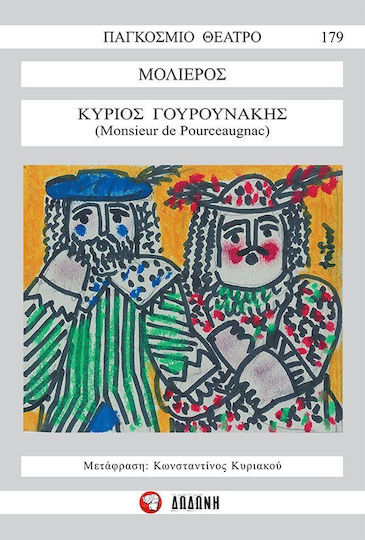
Κύριος Γουρουνάκης

Authors: Molière,Jean Baptiste De Moliere

The first biographer of Molière, Jean-Leonor Le Gallois de Grimarest, informs us (1705) that Molière was inspired to write "Le Bourgeois Gentilhomme" due to a resident of Limoges who, one evening...

The first biographer of Molière, Jean-Leonor Le Gallois de Grimarest, informs us (1705) that Molière was inspired to write "Le Bourgeois Gentilhomme" due to a resident of Limoges who, one evening during a performance, had a fierce argument with the actors and revealed, in all its glory, his absurdity. The author then, to take revenge, made him the hero of...

See full description See full description
  • Language Greek
  • Number of pages Number of pages 124
  • Cover Cover Soft
  • Year of publication Year of publication 2013
  • Publisher Publisher Dodoni
  • See all

Description

Description

The first biographer of Molière, Jean-Leonor Le Gallois de Grimarest, informs us (1705) that Molière was inspired to write "Le Bourgeois Gentilhomme" due to a resident of Limoges who, one evening during a performance, had a fierce argument with the actors and revealed, in all its glory, his absurdity. The author then, to take revenge, made him the hero of his play.

According to another view, Molière had the idea to write "Le Bourgeois Gentilhomme" to mock the inhabitants of Limoges, following a trip to Ambazac, where part of the local nobility welcomed him rather coldly. In any case, the comedy was performed with great success both during the author's lifetime and after his death.

At first glance, the story is quite simple: A provincial man goes to Paris to marry Julie, the daughter of Oronte, who, however, loves Éraste, and he loves her too. With the help of Sbrigani, Nérine, and Lucette, Éraste plays such tricks on Le Bourgeois Gentilhomme that, ultimately, he is forced to take the road back to his village, without fulfilling his original desire, that is, the marriage.

In stories where there are forced marriages, everything has a good ending, as comedy dictates. On one hand, the 'good' lovers who prioritize their feelings over money, and on the other, those who use their age, the power they have, as well as money, to succeed in getting married, which they usually do not achieve.

In the play "Monsieur de Bourgeois Gentilhomme," however, things are more complicated: The good and the bad intermingle to such an extent that we ultimately do not know who wins and who loses and whether we should rejoice in the happy ending of the couple or sympathize more with poor Le Bourgeois Gentilhomme than with the couple at risk of not tying the bonds of marriage.
Manufacturer

See full description

Specifications

Specifications

Authors
Molière, Jean Baptiste De Moliere
Publisher
Dodoni
Original Title
Monsieur de Pourceaugnac
Language
Greek
Cover
Soft
Number of Pages
124
Release Date
12/2013
Publication Date
2013
Award
-
Dimensions
14x21 cm
Art Movement
Classicism, Modernism
Art Albums
Yes
ISBN-13
9789605580377

Important information

Specifications are collected from official manufacturer websites. Please verify the specifications before proceeding with your final purchase. If you notice any problem you can report it here.

See all specifications

Description & Specifications

The first biographer of Molière, Jean-Leonor Le Gallois de Grimarest, informs us (1705) that Molière was inspired to write "Le Bourgeois Gentilhomme" due to a resident of Limoges who, one evening during a performance, had a fierce argument with the actors and revealed, in all its glory, his absurdity. The author then, to take revenge, made him the hero of his play.

According to another view, Molière had the idea to write "Le Bourgeois Gentilhomme" to mock the inhabitants of Limoges, following a trip to Ambazac, where part of the local nobility welcomed him rather coldly. In any case, the comedy was performed with great success both during the author's lifetime and after his death.

At first glance, the story is quite simple: A provincial man goes to Paris to marry Julie, the daughter of Oronte, who, however, loves Éraste, and he loves her too. With the help of Sbrigani, Nérine, and Lucette, Éraste plays such tricks on Le Bourgeois Gentilhomme that, ultimately, he is forced to take the road back to his village, without fulfilling his original desire, that is, the marriage.

In stories where there are forced marriages, everything has a good ending, as comedy dictates. On one hand, the 'good' lovers who prioritize their feelings over money, and on the other, those who use their age, the power they have, as well as money, to succeed in getting married, which they usually do not achieve.

In the play "Monsieur de Bourgeois Gentilhomme," however, things are more complicated: The good and the bad intermingle to such an extent that we ultimately do not know who wins and who loses and whether we should rejoice in the happy ending of the couple or sympathize more with poor Le Bourgeois Gentilhomme than with the couple at risk of not tying the bonds of marriage.

Manufacturer

Authors
Molière, Jean Baptiste De Moliere
Publisher
Dodoni
Original Title
Monsieur de Pourceaugnac
Language
Greek
Cover
Soft
Number of Pages
124
Release Date
12/2013
Publication Date
2013
Award
-
Dimensions
14x21 cm
Art Movement
Classicism, Modernism
Art Albums
Yes
ISBN-13
9789605580377

Important information

Specifications are collected from official manufacturer websites. Please verify the specifications before proceeding with your final purchase. If you notice any problem you can report it here.

8,90 €
14,00 €   shipping cost