Scientific Books

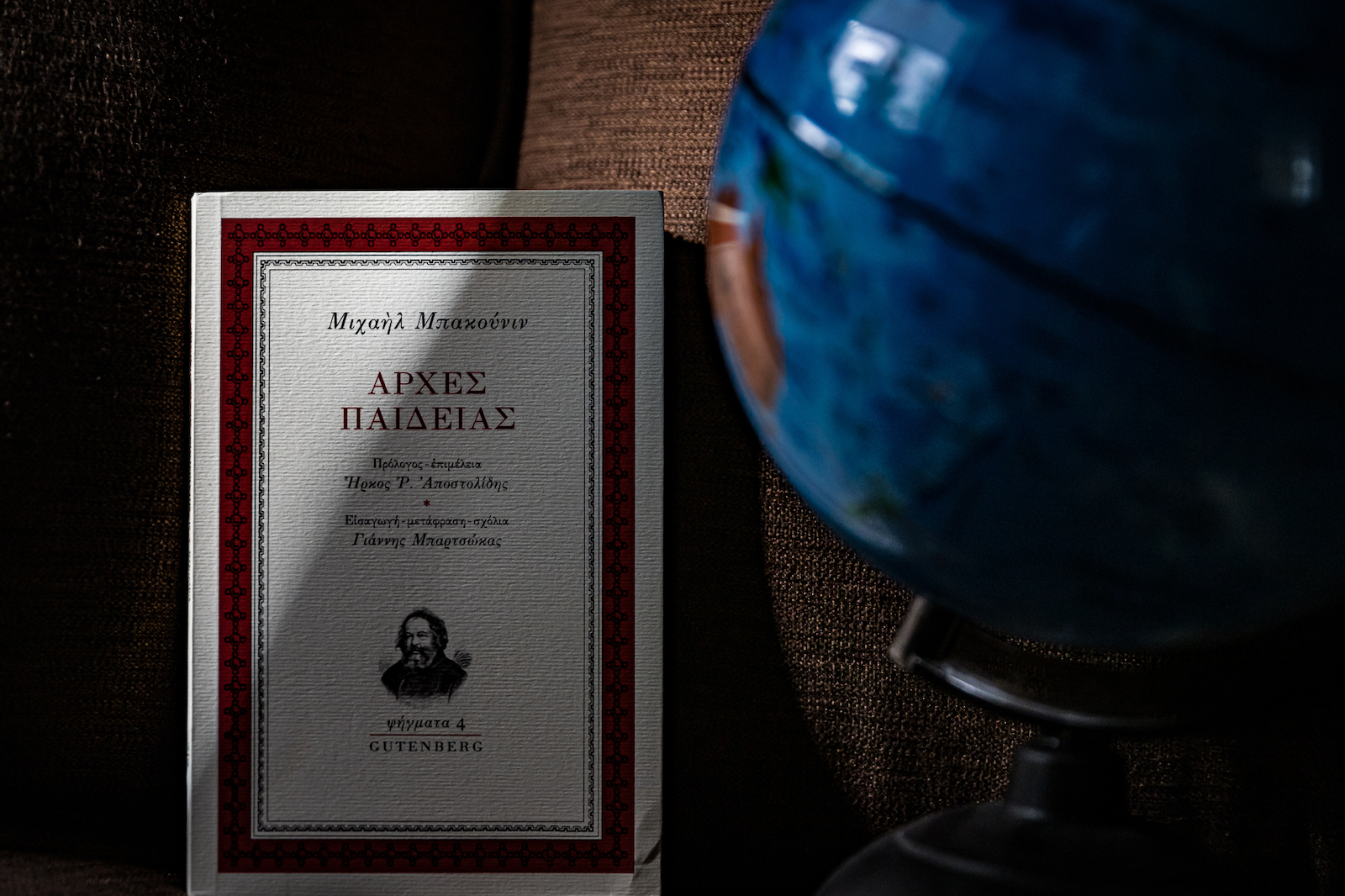
Αρχές Παιδείας

Author: Mikhaïl Bakounine

Thus, an involuntary and fatal submission to all the laws that, independent of any human will, constitute the very life of nature and society; but, also, as much as possible, an absolute autonomy...

Thus, an involuntary and fatal submission to all the laws that, independent of any human will, constitute the very life of nature and society; but, also, as much as possible, an absolute autonomy against any command, against any will – collective and individual – that would demand to be imposed not naturally, but through law and despotism.

Here, Bakunin also...

See full description See full description
  • Language Greek
  • Number of pages Number of pages 95
  • Cover Cover Soft
  • Year of publication Year of publication 2024
  • Publisher Publisher Gutenberg
  • See all

Description

Description

Thus, an involuntary and fatal submission to all the laws that, independent of any human will, constitute the very life of nature and society; but, also, as much as possible, an absolute autonomy against any command, against any will – collective and individual – that would demand to be imposed not naturally, but through law and despotism.

Here, Bakunin also delivers a sermon – a fiery sermon, with a purpose at its core: education, the shaping of free, rebellious consciences, that will obey only the laws, as he says, of nature, and not those from the outside, from above, the state. He seeks to mold new people, who will sweep away the old world, will tear it down to its foundations, to build a new one.

Manufacturer

See full description

Specifications

Specifications

Author
Mikhaïl Bakounine
Publisher
Gutenberg
Type
Natural Sciences
Language
Greek
Subtitle
-
Cover
Soft
Number of Pages
95
Release Date
12/2024
Publication Date
2024
Dimensions
-
ISBN-13
9789600126099

Important information

Specifications are collected from official manufacturer websites. Please verify the specifications before proceeding with your final purchase. If you notice any problem you can report it here.

See all specifications

Reviews (2)

Reviews

  1. 2
  2. 4 stars
    0
  3. 3 stars
    0
  4. 2 stars
    0
  5. 1 star
    0
Review this product

Reviews by our members

  • Giorgos_Sardelis.
    5
    2 out of 2 members found this review helpful

    Verified purchase

    Bakunin, starting from the social revolution, engages with education. Having withdrawn from the Peace and Freedom League in 1868, whose members (Hugo, Mill, Garibaldi, etc.) he characterizes as bourgeois socialists, he writes "Principles of Education" in 1869. In this text, both its value and some of its "sins" (obsessions, lack of clear structure, absence of tangible conclusions, failure to disengage from influences, etc.) are evident.
    Bakunin's study today raises more questions than in the past. Not only due to the excessive simplicity with which he addresses complex issues, but also because we now know more thanks to the neoliberalism as it is applied. This, of course, does not diminish his contribution at all, remaining absolutely timeless, when he considers knowledge and cultivation as power and a "means" to achieve self-awareness, freedom, and happiness.
    The easy question is whether education will make us better or, more accurately according to the anarchist view, if it will make us good people again; so good that we will not need a Leviathan? The answer is no.
    The difficult question is whether the goal of education should be the shaping of the person that will lead him to revolution or the nurturing of revolutionaries, who when liberated will reach a higher self? Bakunin answers, overlooking, however, the possibility that the revolution he seeks may simply change the form of what he wants to destroy and ultimately that may reappear in another form - perhaps more brutal.

    Translated from Greek ·
    Did you find this review helpful?
  • Verified purchase

  • Bakunin, starting from the social revolution, engages with education. Having withdrawn from the Peace and Freedom League in 1868, whose members (Hugo, Mill, Garibaldi, etc.) he characterizes as bourgeois socialists, he writes "Principles of Education" in 1869. In this text, both its value and some of its "sins" (obsessions, lack of clear structure, absence of tangible conclusions, failure to disengage from influences, etc.) are evident.
    Bakunin's study today raises more questions than in the past. Not only due to the excessive simplicity with which he addresses complex issues, but also because we now know more thanks to the neoliberalism as it is applied. This, of course, does not diminish his contribution at all, remaining absolutely timeless, when he considers knowledge and cultivation as power and a "means" to achieve self-awareness, freedom, and happiness.
    The easy question is whether education will make us better or, more accurately according to the anarchist view, if it will make us good people again; so good that we will not need a Leviathan? The answer is no.
    The difficult question is whether the goal of education should be the shaping of the person that will lead him to revolution or the nurturing of revolutionaries, who when liberated will reach a higher self? Bakunin answers, overlooking, however, the possibility that the revolution he seeks may simply change the form of what he wants to destroy and ultimately that may reappear in another form - perhaps more brutal.

    Translated from Greek ·
    2
  • 0
  • See all

Description & Specifications

Thus, an involuntary and fatal submission to all the laws that, independent of any human will, constitute the very life of nature and society; but, also, as much as possible, an absolute autonomy against any command, against any will – collective and individual – that would demand to be imposed not naturally, but through law and despotism.

Here, Bakunin also delivers a sermon – a fiery sermon, with a purpose at its core: education, the shaping of free, rebellious consciences, that will obey only the laws, as he says, of nature, and not those from the outside, from above, the state. He seeks to mold new people, who will sweep away the old world, will tear it down to its foundations, to build a new one.

Manufacturer

Author
Mikhaïl Bakounine
Publisher
Gutenberg
Type
Natural Sciences
Language
Greek
Subtitle
-
Cover
Soft
Number of Pages
95
Release Date
12/2024
Publication Date
2024
Dimensions
-
ISBN-13
9789600126099

Important information

Specifications are collected from official manufacturer websites. Please verify the specifications before proceeding with your final purchase. If you notice any problem you can report it here.

Reviews (2)

  1. 2
  2. 4 stars
    0
  3. 3 stars
    0
  4. 2 stars
    0
  5. 1 star
    0
Review this product

Reviews by our members

  • Giorgos_Sardelis.
    5
    2 out of 2 members found this review helpful

    Verified purchase

    Bakunin, starting from the social revolution, engages with education. Having withdrawn from the Peace and Freedom League in 1868, whose members (Hugo, Mill, Garibaldi, etc.) he characterizes as bourgeois socialists, he writes "Principles of Education" in 1869. In this text, both its value and some of its "sins" (obsessions, lack of clear structure, absence of tangible conclusions, failure to disengage from influences, etc.) are evident.
    Bakunin's study today raises more questions than in the past. Not only due to the excessive simplicity with which he addresses complex issues, but also because we now know more thanks to the neoliberalism as it is applied. This, of course, does not diminish his contribution at all, remaining absolutely timeless, when he considers knowledge and cultivation as power and a "means" to achieve self-awareness, freedom, and happiness.
    The easy question is whether education will make us better or, more accurately according to the anarchist view, if it will make us good people again; so good that we will not need a Leviathan? The answer is no.
    The difficult question is whether the goal of education should be the shaping of the person that will lead him to revolution or the nurturing of revolutionaries, who when liberated will reach a higher self? Bakunin answers, overlooking, however, the possibility that the revolution he seeks may simply change the form of what he wants to destroy and ultimately that may reappear in another form - perhaps more brutal.

    Translated from Greek ·
    Did you find this review helpful?
  • Verified purchase

  • Bakunin, starting from the social revolution, engages with education. Having withdrawn from the Peace and Freedom League in 1868, whose members (Hugo, Mill, Garibaldi, etc.) he characterizes as bourgeois socialists, he writes "Principles of Education" in 1869. In this text, both its value and some of its "sins" (obsessions, lack of clear structure, absence of tangible conclusions, failure to disengage from influences, etc.) are evident.
    Bakunin's study today raises more questions than in the past. Not only due to the excessive simplicity with which he addresses complex issues, but also because we now know more thanks to the neoliberalism as it is applied. This, of course, does not diminish his contribution at all, remaining absolutely timeless, when he considers knowledge and cultivation as power and a "means" to achieve self-awareness, freedom, and happiness.
    The easy question is whether education will make us better or, more accurately according to the anarchist view, if it will make us good people again; so good that we will not need a Leviathan? The answer is no.
    The difficult question is whether the goal of education should be the shaping of the person that will lead him to revolution or the nurturing of revolutionaries, who when liberated will reach a higher self? Bakunin answers, overlooking, however, the possibility that the revolution he seeks may simply change the form of what he wants to destroy and ultimately that may reappear in another form - perhaps more brutal.

    Translated from Greek ·
    2
  • 0
  • See all
7,05 €
14,00 €   shipping cost