


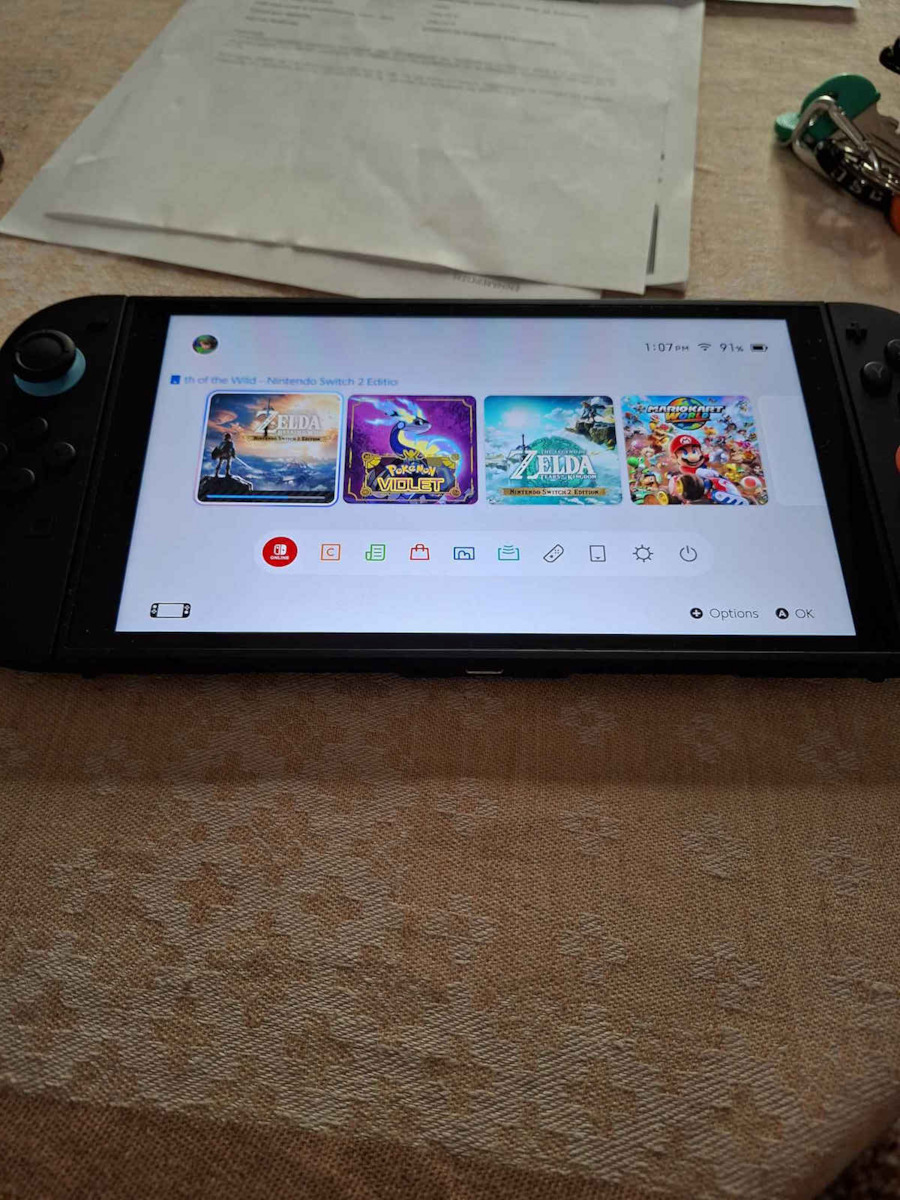
The Nintendo Switch 2 has significant upgrades compared to the original Nintendo Switch from 2017. Below are the main differences between the two models:
Design & Display
Nintendo Switch (2017):
- 6.2" LCD screen, 720p resolution, 60Hz.
- Supports only 1080p in docked mode.
- Basic Joy-Con with standard HD Rumble vibration.
Nintendo Switch 2 (2025):
- 7.9" LCD screen, 1080p resolution, HDR support and refresh rate up to 120Hz.
- Supports 4K/60fps in docked mode.
- New Joy-Con 2 with mouse mode, improved buttons, and HD 2 vibration.
Processor & Performance
Nintendo Switch:
- SoC: Nvidia Tegra X1 (ARM Cortex-A57, Maxwell GPU).
- RAM: 4GB LPDDR4.
- GPU performance: ~0.5 TFLOPS.
Nintendo Switch 2:
- SoC: Nvidia Tegra T239 with 8 ARM Cortex-A78C cores.
- GPU: Ampere architecture with 1536 CUDA cores, support for ray tracing and DLSS.
- RAM: 12GB LPDDR5X.
- GPU performance: ~3.09 TFLOPS in docked mode, ~1.72 TFLOPS in handheld.
Storage & Connectivity
Nintendo Switch:
- Internal storage: 32GB.
- microSD support up to 2TB.
- Wi-Fi 5, Bluetooth 4.1.
Nintendo Switch 2:
- Internal storage: 256GB UFS 3.1.
- microSD Express support up to 2TB.
- Wi-Fi 6, Bluetooth 5.0, two USB-C ports, built-in microphone with noise cancellation.
Battery Life & Features
Nintendo Switch:
- Battery life: 2.5 to 6.5 hours.
- Basic features without built-in microphone or camera.
Nintendo Switch 2:
- Battery life: 2 to 6.5 hours.
- New features such as GameChat, Gameshare, and support for camera connection via USB-C.
Games & Compatibility
Nintendo Switch:
- Large game library, no support for DLSS or ray tracing.
Nintendo Switch 2:
- Compatible with most games from the original Switch.
- New exclusive games such as Mario Kart World, Metroid Prime 4: Beyond, and Elden Ring Tarnished Edition.
- Support for GameCube games via Nintendo Switch Online.


