

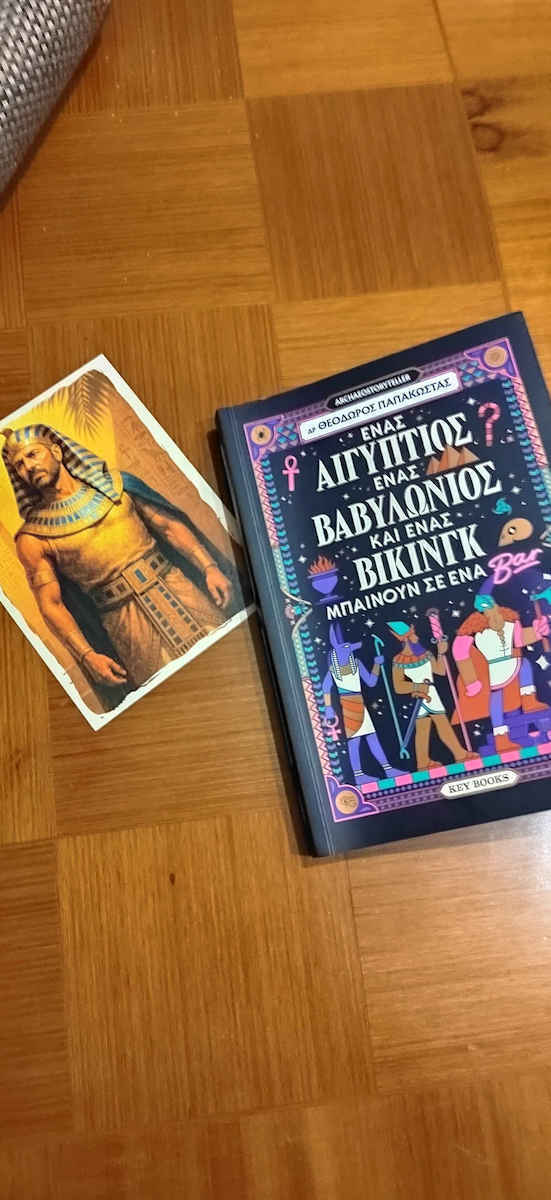


Which Pharaoh abolished the ancient gods and the entire priesthood, creating his own god? Why did Egyptian workers go on mass strikes against the Pharaoh? How did Osiris become the ancient god of resurrection? How did the goddess Isis win a trial when she had been forbidden to enter the court? Which Babylonian princess is the first named writer in the world? Why is the Epic of Gilgamesh the first book of self-awareness in history? How could there have been Bluetooth in Viking Scandinavia? How did the Vikings reach America and what happened to those who arrived? Why did Thor dress as a bride and how did Odin lose his eye? The civilizations and mythologies of the world unfold their most fascinating stories.
[…] I attended his first class, I remember it was a Friday morning, and it was as if I had entered a time capsule with an IMAX screen. The stern, mustachioed elderly professor in front of the classroom blackboard was transforming into something else. How much he loved what he taught! How much he enjoyed sharing his science! I was enchanted. His slides and his way of describing what he was saying made us forget we were in class and eagerly await his next sentence.
What’s the funny thing?
Heinrich (yes, we called him by his first name) was from Hamelin, Germany. From the same place as the Pied Piper of Hamelin. Do you remember him? He was the piper who, with his magic flute, drove the mice out of the city, and when he wasn’t paid, he played his flute again and took the city’s children with him.
That’s how Heinrich enchanted us too.
With him, I discovered the magic of the heritage of northern Europe, that wherever there is humanity, there is archaeology, and every small story of people can become fascinating, and I can honestly confess that since then he was the only one whose lectures I never missed, and I would always look forward to those two hours on Friday.
Thank you, Heinrich, for those journeys.