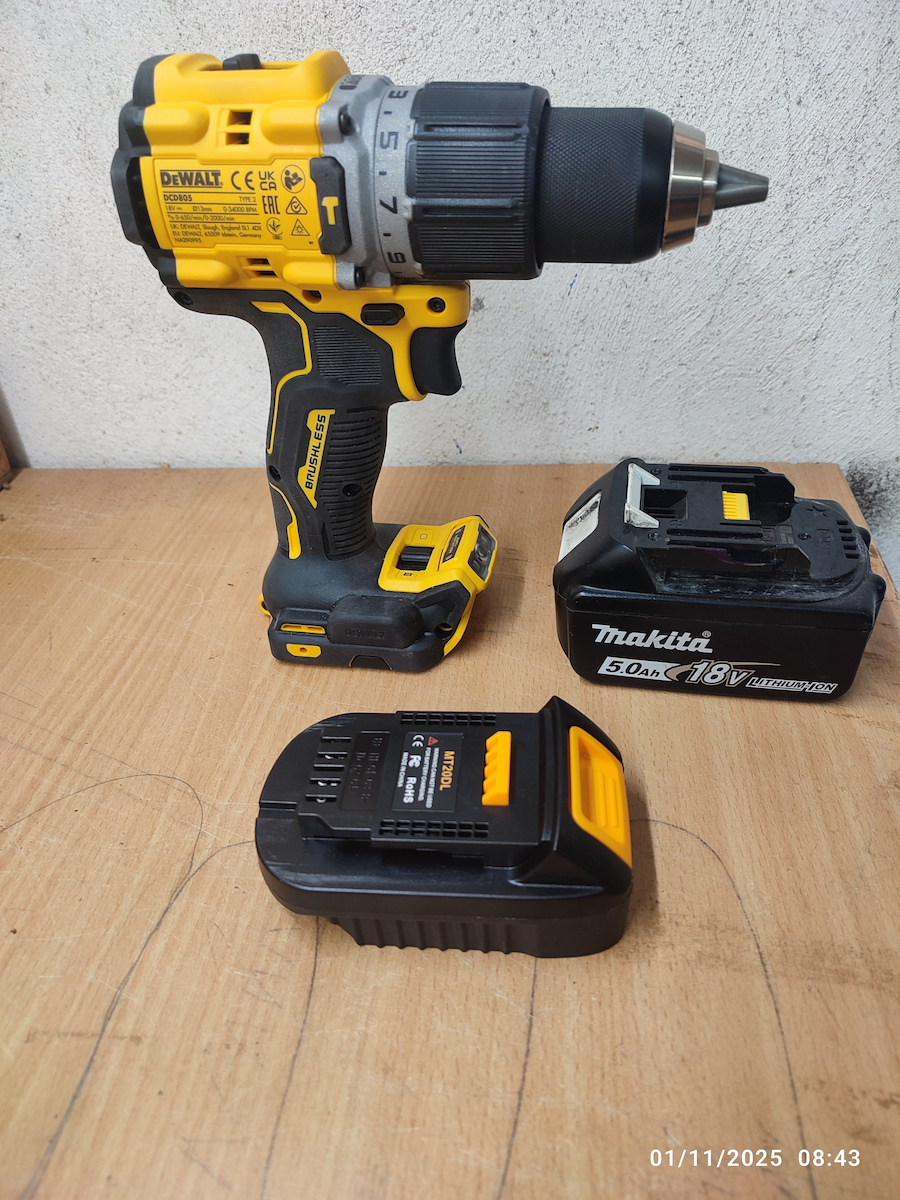
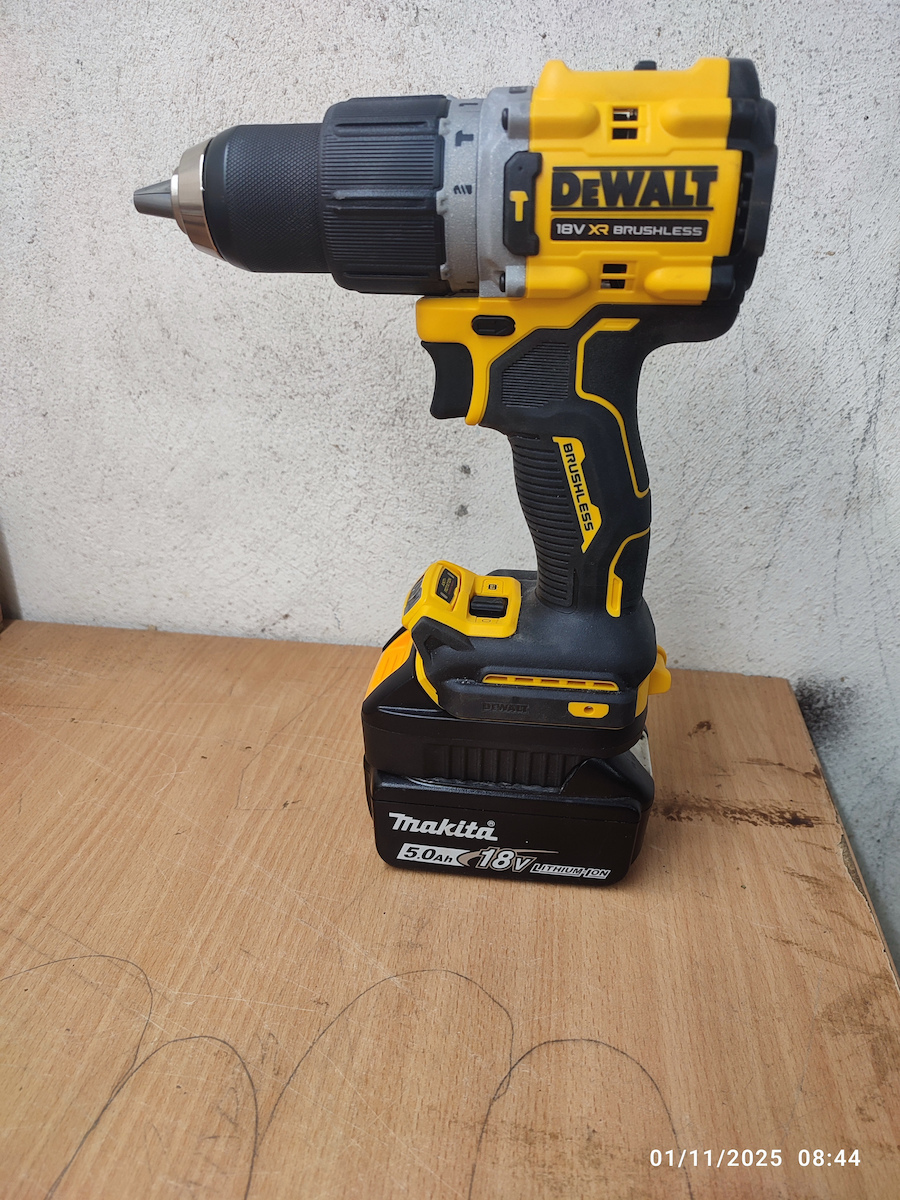
Very powerful and lightweight tool, with excellent lighting that doesn’t cast a shadow on the drilling spot.
It replaced a Makita BHP451 (80 Nm) whose gearbox had broken. At first, I was thinking of getting the Makita DHP484Z (54 Nm), which costs about the same as the DeWalt, since I already have a set with Makita batteries.
In the end, I preferred to use DeWalt with an MT20DL battery adapter, due to its greater power and better drilling in concrete. (With the adapter, the tool is about 3 cm taller.)
The DeWalt drills concrete in almost half the time compared to the old BHP451, but also—as shown in tests on YouTube—compared to the Makita DHP484Z.
I’m talking about concrete, not just a regular wall. On a wall, the differences are small, but the power of the DeWalt is really noticeable.
Apart from the power and the higher number of impacts (34,000 versus 30,000 for the DHP484Z), I think the DeWalt also has a longer impact stroke, because when you drill concrete you can really feel its impacts—unlike the Makita, which gives the impression you’re drilling with a screwdriver.
Here’s a characteristic test with the previous DeWalt model, the DCD796 (70 Nm), and the DHP484Z (54 Nm):
https://www.youtube.com/watch?v=Cre6HSlRpRU
After a lot of research, I’ll say that my statistics showed me that DeWalts might break a little more easily than Makitas, but they excel in power and price.
Makitas are more "restrained" in construction, they don’t drill concrete as easily, but probably offer greater reliability—even though they are more expensive.
In terms of reliability, though, my personal experience contradicts my "YouTube statistics," since all the DeWalt corded tools I have still work perfectly (while the Makita broke).
I have several DeWalt tools, some over 15 years old, and I’m just waiting for them to break so I can replace them with new models because I feel bad throwing them away!
I highly recommend it and I think you’ll enjoy it, both in terms of comfort and power.
Πολύ δυνατό και ελαφρύ εργαλείο, με εξαιρετικό φωτισμό που δεν σκιάζει το σημείο τρυπήματος.
Αντικατέστησε ένα Makita BHP451 (80 Nm) του οποίου είχε χαλάσει το σασμάν. Αρχικά σκεφτόμουν να πάρω το Makita DHP484Z (54 Nm), που κοστίζει περίπου τα ίδια με το DeWalt, αφού έχω ήδη σετ με μπαταρίες Makita.
Τελικά προτίμησα να χρησιμοποιήσω DeWalt με αντάπτορα μπαταρίας MT20DL, λόγω μεγαλύτερης δύναμης και καλύτερης διάτρησης σε μπετόν. (Με τον αντάπτορα το εργαλείο ψηλώνει περίπου 3 cm.)
Το DeWalt τρυπάει μπετόν σχεδόν στο μισό χρόνο σε σχέση με το παλιό BHP451, αλλά και —όπως φαίνεται και σε δοκιμές στο YouTube— σε σχέση με το Makita DHP484Z.
Μιλάω για μπετόν, όχι για απλό τοίχο. Στον τοίχο οι διαφορές είναι μικρές, όμως η δύναμη του DeWalt είναι πραγματικά αισθητή.
Εκτός από τη δύναμη και τον μεγαλύτερο αριθμό κρούσεων (34 000 έναντι 30 000 του DHP484Z), νομίζω πως το DeWalt έχει και μεγαλύτερη διαδρομή κρούσης, γιατί όταν τρυπάς μπετόν νιώθεις πολύ έντονα τις κρούσεις του — σε αντίθεση με το Makita, που δίνει την εντύπωση ότι τρυπάς με βιδολόγο.
Εδώ είναι ένα χαρακτηριστικό τεστ με το προηγούμενο μοντέλο της DeWalt, το DCD796 (70 Nm), και το DHP484Z (54 Nm):
https://www.youtube.com/watch?v=Cre6HSlRpRU
Μετά από πολύ ψάξιμο, θα πω ότι οι στατιστικές μου έδειξαν πως τα DeWalt ίσως χαλάνε λίγο πιο εύκολα από τα Makita, όμως υπερτερούν σε δύναμη και τιμή.
Τα Makita είναι πιο «συγκρατημένα» κατασκευαστικά, δεν τρυπάνε το μπετόν με την ίδια ευκολία, αλλά πιθανόν προσφέρουν μεγαλύτερη αξιοπιστία — αν και είναι πιο ακριβά.
Από πλευράς αξιοπιστίας πάντως, η προσωπική μου εμπειρία διαψεύδει τη «στατιστική μου του YouTube», αφού ό,τι DeWalt ρεύματος έχω, δουλεύει ακόμα άψογα (ενώ το Makita χάλασε).
Έχω αρκετά εργαλεία DeWalt πάνω από 15 χρόνια μερικά και απλώς περιμένω να χαλάσουν για να τα αντικαταστήσω με νεα μοντελα γιατί λυπάμαι να τα πετάξω!
Το συστήνω ανεπιφύλακτα και νομίζω θα το ευχαριστηθείτε, και απο θέμα άνεσης και απο θέμα δύναμης.