Philosophy Books

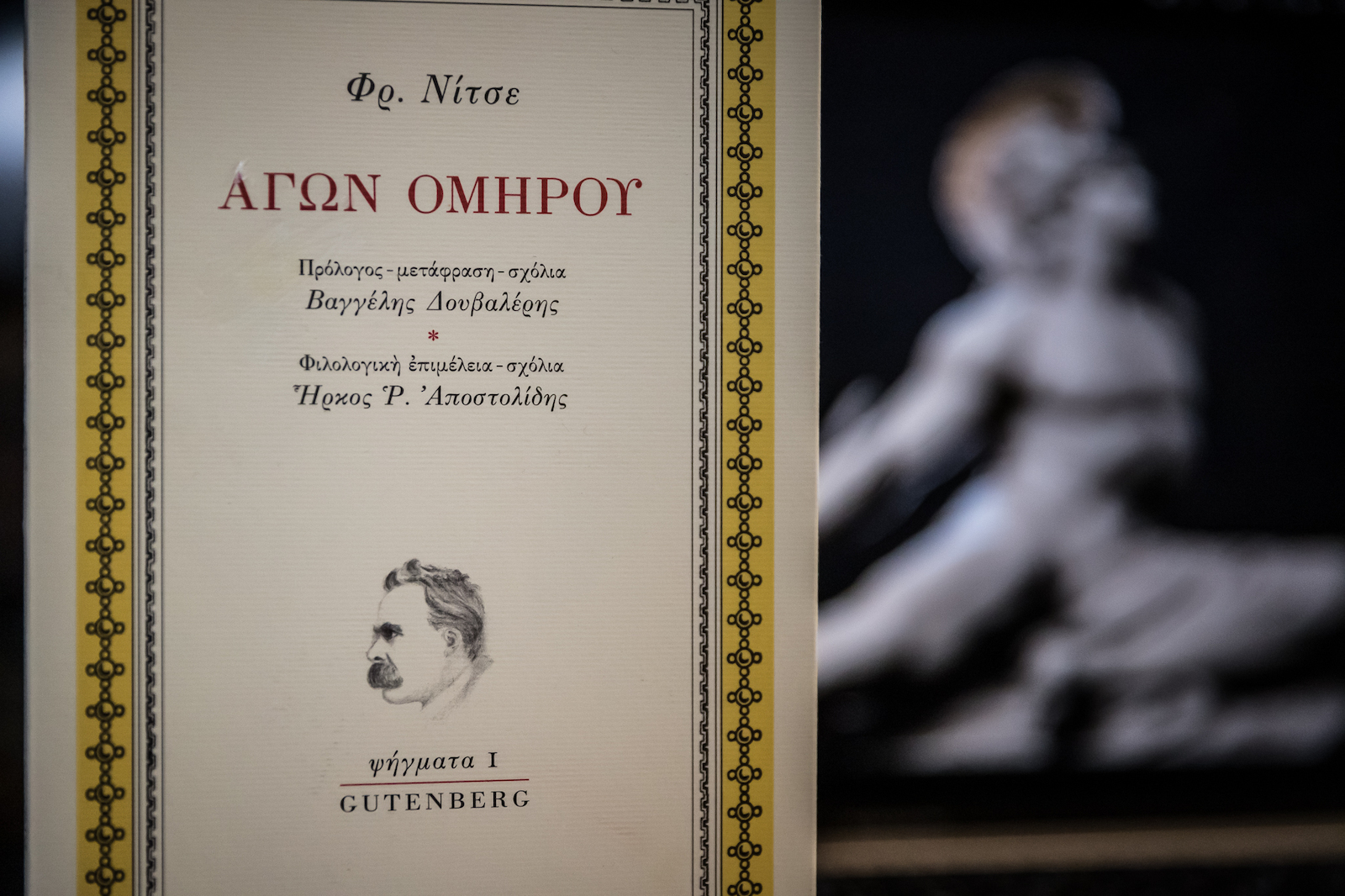
Αγών Ομήρου

Author: Friedrich Wilhelm Nietzsche

Almost everything we call "higher culture" is based on the exhalation of brutality. The painful sweetness that tragedy emits has its basis in the inhuman, the wild.

The so-called mercy of tragedy, as...

Almost everything we call "higher culture" is based on the exhalation of brutality. The painful sweetness that tragedy emits has its basis in the inhuman, the wild.

The so-called mercy of tragedy, as well as everything lofty, such as the higher and sweetest shivers of metaphysics, draws its sweetness exclusively from the components of wildness it contains.

...

See full description See full description

Description

Description

Almost everything we call "higher culture" is based on the exhalation of brutality. The painful sweetness that tragedy emits has its basis in the inhuman, the wild.

The so-called mercy of tragedy, as well as everything lofty, such as the higher and sweetest shivers of metaphysics, draws its sweetness exclusively from the components of wildness it contains.

The Romans with their arenas, the Christians in the ecstasy of the Cross, the Spaniards with their gallows and bullfights, the workers in the Parisian suburbs who yearn for bloody revolutions - all enjoy and ardently seek to drink the intoxicating brew of the great Circe "Wildness".

Manufacturer

See full description

Specifications

Specifications

Author
Friedrich Wilhelm Nietzsche
Publisher
Gutenberg
Cover
Soft
Number of Pages
96
Dimensions
14x21 cm
Original Title
Homer's Wettkampf
Release Date
7/2015
Publication Date
2015
Language
Greek
ISBN-13
9789600117080

Important information

Specifications are collected from official manufacturer websites. Please verify the specifications before proceeding with your final purchase. If you notice any problem you can report it here.

See all specifications

Reviews (2)

Reviews

  1. 2
  2. 4 stars
    0
  3. 3 stars
    0
  4. 2 stars
    0
  5. 1 star
    0
Review this product

Reviews by our members

  • Giorgos_Sardelis.

    Verified purchase

    To argue means to quarrel, to fight, to struggle. This is well known. However, it is not widely known that to argue is synonymous with to strive and to challenge. In the Homeric epics, Eris was the goddess of strife - sister and companion of Ares, while Hesiod considers her the daughter of Night and distinguishes two kinds of strife: the bad one, mother of all evils (Pain, Forgetfulness, Murder, etc.) and the good one (noble competition). Could strife be a virtue and a driving force for the birth of ancient Greek philosophy, the democracy of sports (Olympic games), and generally of Greek and consequently Western civilization?

    In 1870, Nietzsche wrote to the lawyer Karl von Gersdorff: “I attend his weekly lectures at the University on the study of history and I believe I am the only one among the sixty listeners who perceives the deep course of his thought with all its curious descriptions and abrupt pauses, where the subject approaches the ambiguous. For the first time in my life, I enjoy a lecture and moreover, it is the kind of lecture that I will be able to give when I am older.” He was referring to the great Swiss art and cultural historian, Jacob Burckhardt.

    Burckhardt rejected the determinism of the Hegelian school of historiography and played a crucial role in shaping a new form of history, which became known in German as kulturgeschichte, “cultural history.” Cultural history recorded and interpreted the events of the past through their social, cultural, and political contexts as well as through the art and behaviors - traditions of each culture.

    However, the problem with the study of festivals, customs, behavioral patterns, and other forms of folk expression was that the findings, techniques, and technology required for such studies were not always available, especially during Burckhardt's time. Thus, the study of a culture often depended on its elites and the assumption that this culture was fully conscious and recorded in the literature and art of the period.

    Until Burckhardt, the methods of understanding, recounting, and narrating the past were dominated by the form of Georg Wilhelm Friedrich Hegel (or Hegel). Subsequently, the Marxist - materialist - approach (which is based on the Hegelian) established itself as a more convincing explanation of the meaning of historical events. However, Marxist historical materialism failed to erase the allure that history has spiritual/intellectual dimensions. Nevertheless, history during the era of 19th-century historicism played the same role as sociology and anthropology do today.
    Historicism approaches the explanation of social and political phenomena (including ideas and beliefs) through the study of the process/history from which they emerged. Historicism is a useful tool in creating contextual theories and narratives, to understand how social and cultural phenomena arose. However, it does not take into account folk traditions, beliefs, prejudices, superstitions, etc.
    Thus, history replaced philosophy as the basis for the study of human nature and the explanation of human societies until Nietzsche came and challenged the assumptions of historicism. And in this attack by Nietzsche on historicism, the views of Jacob Burckhardt played a role.

    Nietzsche was influenced by this great historian. The two shared the belief that competition - the desire for primacy and excellence - was at the center of the worldview of the ancient Greeks. Nietzsche likely arrived at this conclusion on his own, and Burckhardt simply confirmed or organized it for him. However, from a certain point onward, it seems that each contributed to the other's thinking.

    The concept of the ancient Greek "struggle" is omnipresent in all of Nietzsche's works, playing the role of a compass in his worldview.

    Translated from Greek ·
    Did you find this review helpful?
  • Verified purchase

    • Paper quality
    • Was it easy to read?
    • Was it interesting enough?
    • I liked the writing style
    • I would read a book by the same author
    • I would recommend it for reading
  • To argue means to quarrel, to fight, to struggle. This is well known. However, it is not widely known that to argue is synonymous with to strive and to challenge. In the Homeric epics, Eris was the goddess of strife - sister and companion of Ares, while Hesiod considers her the daughter of Night and distinguishes two kinds of strife: the bad one, mother of all evils (Pain, Forgetfulness, Murder, etc.) and the good one (noble competition). Could strife be a virtue and a driving force for the birth of ancient Greek philosophy, the democracy of sports (Olympic games), and generally of Greek and consequently Western civilization?

    In 1870, Nietzsche wrote to the lawyer Karl von Gersdorff: “I attend his weekly lectures at the University on the study of history and I believe I am the only one among the sixty listeners who perceives the deep course of his thought with all its curious descriptions and abrupt pauses, where the subject approaches the ambiguous. For the first time in my life, I enjoy a lecture and moreover, it is the kind of lecture that I will be able to give when I am older.” He was referring to the great Swiss art and cultural historian, Jacob Burckhardt.

    Burckhardt rejected the determinism of the Hegelian school of historiography and played a crucial role in shaping a new form of history, which became known in German as kulturgeschichte, “cultural history.” Cultural history recorded and interpreted the events of the past through their social, cultural, and political contexts as well as through the art and behaviors - traditions of each culture.

    However, the problem with the study of festivals, customs, behavioral patterns, and other forms of folk expression was that the findings, techniques, and technology required for such studies were not always available, especially during Burckhardt's time. Thus, the study of a culture often depended on its elites and the assumption that this culture was fully conscious and recorded in the literature and art of the period.

    Until Burckhardt, the methods of understanding, recounting, and narrating the past were dominated by the form of Georg Wilhelm Friedrich Hegel (or Hegel). Subsequently, the Marxist - materialist - approach (which is based on the Hegelian) established itself as a more convincing explanation of the meaning of historical events. However, Marxist historical materialism failed to erase the allure that history has spiritual/intellectual dimensions. Nevertheless, history during the era of 19th-century historicism played the same role as sociology and anthropology do today.
    Historicism approaches the explanation of social and political phenomena (including ideas and beliefs) through the study of the process/history from which they emerged. Historicism is a useful tool in creating contextual theories and narratives, to understand how social and cultural phenomena arose. However, it does not take into account folk traditions, beliefs, prejudices, superstitions, etc.
    Thus, history replaced philosophy as the basis for the study of human nature and the explanation of human societies until Nietzsche came and challenged the assumptions of historicism. And in this attack by Nietzsche on historicism, the views of Jacob Burckhardt played a role.

    Nietzsche was influenced by this great historian. The two shared the belief that competition - the desire for primacy and excellence - was at the center of the worldview of the ancient Greeks. Nietzsche likely arrived at this conclusion on his own, and Burckhardt simply confirmed or organized it for him. However, from a certain point onward, it seems that each contributed to the other's thinking.

    The concept of the ancient Greek "struggle" is omnipresent in all of Nietzsche's works, playing the role of a compass in his worldview.

    Translated from Greek ·
    0
  • 0
  • See all

Description & Specifications

Almost everything we call "higher culture" is based on the exhalation of brutality. The painful sweetness that tragedy emits has its basis in the inhuman, the wild.

The so-called mercy of tragedy, as well as everything lofty, such as the higher and sweetest shivers of metaphysics, draws its sweetness exclusively from the components of wildness it contains.

The Romans with their arenas, the Christians in the ecstasy of the Cross, the Spaniards with their gallows and bullfights, the workers in the Parisian suburbs who yearn for bloody revolutions - all enjoy and ardently seek to drink the intoxicating brew of the great Circe "Wildness".

Manufacturer

Author
Friedrich Wilhelm Nietzsche
Publisher
Gutenberg
Cover
Soft
Number of Pages
96
Dimensions
14x21 cm
Original Title
Homer's Wettkampf
Release Date
7/2015
Publication Date
2015
Language
Greek
ISBN-13
9789600117080

Important information

Specifications are collected from official manufacturer websites. Please verify the specifications before proceeding with your final purchase. If you notice any problem you can report it here.

Reviews (2)

  1. 2
  2. 4 stars
    0
  3. 3 stars
    0
  4. 2 stars
    0
  5. 1 star
    0
Review this product

Reviews by our members

  • Giorgos_Sardelis.

    Verified purchase

    To argue means to quarrel, to fight, to struggle. This is well known. However, it is not widely known that to argue is synonymous with to strive and to challenge. In the Homeric epics, Eris was the goddess of strife - sister and companion of Ares, while Hesiod considers her the daughter of Night and distinguishes two kinds of strife: the bad one, mother of all evils (Pain, Forgetfulness, Murder, etc.) and the good one (noble competition). Could strife be a virtue and a driving force for the birth of ancient Greek philosophy, the democracy of sports (Olympic games), and generally of Greek and consequently Western civilization?

    In 1870, Nietzsche wrote to the lawyer Karl von Gersdorff: “I attend his weekly lectures at the University on the study of history and I believe I am the only one among the sixty listeners who perceives the deep course of his thought with all its curious descriptions and abrupt pauses, where the subject approaches the ambiguous. For the first time in my life, I enjoy a lecture and moreover, it is the kind of lecture that I will be able to give when I am older.” He was referring to the great Swiss art and cultural historian, Jacob Burckhardt.

    Burckhardt rejected the determinism of the Hegelian school of historiography and played a crucial role in shaping a new form of history, which became known in German as kulturgeschichte, “cultural history.” Cultural history recorded and interpreted the events of the past through their social, cultural, and political contexts as well as through the art and behaviors - traditions of each culture.

    However, the problem with the study of festivals, customs, behavioral patterns, and other forms of folk expression was that the findings, techniques, and technology required for such studies were not always available, especially during Burckhardt's time. Thus, the study of a culture often depended on its elites and the assumption that this culture was fully conscious and recorded in the literature and art of the period.

    Until Burckhardt, the methods of understanding, recounting, and narrating the past were dominated by the form of Georg Wilhelm Friedrich Hegel (or Hegel). Subsequently, the Marxist - materialist - approach (which is based on the Hegelian) established itself as a more convincing explanation of the meaning of historical events. However, Marxist historical materialism failed to erase the allure that history has spiritual/intellectual dimensions. Nevertheless, history during the era of 19th-century historicism played the same role as sociology and anthropology do today.
    Historicism approaches the explanation of social and political phenomena (including ideas and beliefs) through the study of the process/history from which they emerged. Historicism is a useful tool in creating contextual theories and narratives, to understand how social and cultural phenomena arose. However, it does not take into account folk traditions, beliefs, prejudices, superstitions, etc.
    Thus, history replaced philosophy as the basis for the study of human nature and the explanation of human societies until Nietzsche came and challenged the assumptions of historicism. And in this attack by Nietzsche on historicism, the views of Jacob Burckhardt played a role.

    Nietzsche was influenced by this great historian. The two shared the belief that competition - the desire for primacy and excellence - was at the center of the worldview of the ancient Greeks. Nietzsche likely arrived at this conclusion on his own, and Burckhardt simply confirmed or organized it for him. However, from a certain point onward, it seems that each contributed to the other's thinking.

    The concept of the ancient Greek "struggle" is omnipresent in all of Nietzsche's works, playing the role of a compass in his worldview.

    Translated from Greek ·
    Did you find this review helpful?
  • Verified purchase

    • Paper quality
    • Was it easy to read?
    • Was it interesting enough?
    • I liked the writing style
    • I would read a book by the same author
    • I would recommend it for reading
  • To argue means to quarrel, to fight, to struggle. This is well known. However, it is not widely known that to argue is synonymous with to strive and to challenge. In the Homeric epics, Eris was the goddess of strife - sister and companion of Ares, while Hesiod considers her the daughter of Night and distinguishes two kinds of strife: the bad one, mother of all evils (Pain, Forgetfulness, Murder, etc.) and the good one (noble competition). Could strife be a virtue and a driving force for the birth of ancient Greek philosophy, the democracy of sports (Olympic games), and generally of Greek and consequently Western civilization?

    In 1870, Nietzsche wrote to the lawyer Karl von Gersdorff: “I attend his weekly lectures at the University on the study of history and I believe I am the only one among the sixty listeners who perceives the deep course of his thought with all its curious descriptions and abrupt pauses, where the subject approaches the ambiguous. For the first time in my life, I enjoy a lecture and moreover, it is the kind of lecture that I will be able to give when I am older.” He was referring to the great Swiss art and cultural historian, Jacob Burckhardt.

    Burckhardt rejected the determinism of the Hegelian school of historiography and played a crucial role in shaping a new form of history, which became known in German as kulturgeschichte, “cultural history.” Cultural history recorded and interpreted the events of the past through their social, cultural, and political contexts as well as through the art and behaviors - traditions of each culture.

    However, the problem with the study of festivals, customs, behavioral patterns, and other forms of folk expression was that the findings, techniques, and technology required for such studies were not always available, especially during Burckhardt's time. Thus, the study of a culture often depended on its elites and the assumption that this culture was fully conscious and recorded in the literature and art of the period.

    Until Burckhardt, the methods of understanding, recounting, and narrating the past were dominated by the form of Georg Wilhelm Friedrich Hegel (or Hegel). Subsequently, the Marxist - materialist - approach (which is based on the Hegelian) established itself as a more convincing explanation of the meaning of historical events. However, Marxist historical materialism failed to erase the allure that history has spiritual/intellectual dimensions. Nevertheless, history during the era of 19th-century historicism played the same role as sociology and anthropology do today.
    Historicism approaches the explanation of social and political phenomena (including ideas and beliefs) through the study of the process/history from which they emerged. Historicism is a useful tool in creating contextual theories and narratives, to understand how social and cultural phenomena arose. However, it does not take into account folk traditions, beliefs, prejudices, superstitions, etc.
    Thus, history replaced philosophy as the basis for the study of human nature and the explanation of human societies until Nietzsche came and challenged the assumptions of historicism. And in this attack by Nietzsche on historicism, the views of Jacob Burckhardt played a role.

    Nietzsche was influenced by this great historian. The two shared the belief that competition - the desire for primacy and excellence - was at the center of the worldview of the ancient Greeks. Nietzsche likely arrived at this conclusion on his own, and Burckhardt simply confirmed or organized it for him. However, from a certain point onward, it seems that each contributed to the other's thinking.

    The concept of the ancient Greek "struggle" is omnipresent in all of Nietzsche's works, playing the role of a compass in his worldview.

    Translated from Greek ·
    0
  • 0
  • See all
4,80 €
14,00 €   shipping cost