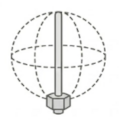
Omnidirectional: They emit signals in all horizontal directions (360 degrees). Suitable for networks where users or devices are located around the antenna. Not efficient for long-distance communication.
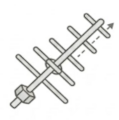
Directional: They focus the transmission in a specific direction. Greater range compared to Omnidirectional. Requires precise alignment with the target device.
Sectorial: They emit in a specific arc (e.g., 60°, 90°, 120°). Good balance between coverage and directionality. Multiple antennas are required for full 360° coverage.
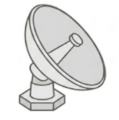
Parabolic: They use a parabolic reflector for highly concentrated transmission. Excellent performance for long-distance communication. Require precision in alignment.
Indoor Signal Boost: Ideal for replacing the router's factory antennas, offering wider coverage in all directions within the space.
Point-to-Point Connection: Designed to send a "beam" signal to a specific point (e.g. from a house to a warehouse or an opposite building) over long distances.
4G/5G Router Signal Enhancement: Special external antennas that connect to routers with a SIM card for more stable internet and higher speeds in areas with weak mobile signal.
(802.11ax Extended) Adds the new 6 GHz band. Almost zero interference and next-generation speeds. Requires a compatible Wi-Fi 6E router/card.
Wi‑Fi 7: (802.11be) The cutting edge of technology. Maximum bandwidth (320MHz) for Extreme Gaming and 8K Video. The top choice for future-proof use.
Wi‑Fi 6: (802.11ax) Modern standard for 2.4 GHz & 5 GHz. Offers stability in areas with many connected devices and reduced lag.
Wi‑Fi 5: (802.11ac) High speeds on the 5 GHz band. Ideal for HD streaming and gaming. Requires line of sight or short distances for maximum performance.
Wi‑Fi 4: (802.11n) Basic coverage. Operates mainly at 2.4 GHz. Suitable for simple browsing, smart home devices, and long distances with low speed.