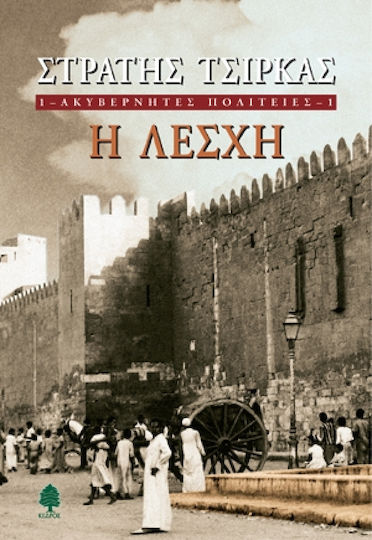
The Ungoverned States by Stratis Tsirkas primarily covers the events of the period 1942-1944, the most critical period of the Second World War. At the same time, the work includes scenes from the history of colonial Egypt in the 19th century, as well as from post-civil war Greece in the 1950s.
The time and place of the narrative alternates around three cities where the novel's action unfolds. In the Jerusalem of the Club, in the Cairo of Ariadne, and in the Alexandria of the Bat, we follow the movements of the fictional characters, swept away by the 'fortunes of war', the refugee dispersion, and the anti-fascist struggle.
Key points of the narrative include Rommel's attack and the forced refugee crisis of the populations in the Middle East in Jerusalem during the summer of 1942 (Club), the events of the dissolution of the 2nd Brigade of the armed forces in July 1943 (Ariadne), and the April movement of 1944 (Bat). The author composes a literary testimony aimed at restoring the resistance in the Middle East while also highlighting the 'severed heads', the individuals and mechanisms that contributed to the marginalization and stigmatization of the protagonists of April 1944.
History, love, and politics: a triangle that unites human passions with social struggles. The wandering of the heroes in the ever-new space of the 'ungoverned states' brings to the forefront the perspective of the outsider, the refugee, the exile, the hunted. A microcosm that captures all the pathology of war: the fear of death and the anguish of survival, the psychological resistances and the fighting spirit, the human weaknesses, the meeting and confrontation with the other.
The central hero of the trilogy is Manos Simonidis; a thirty-something leftist intellectual who comes to the Middle East after the Albanian front and connects with illegal anti-fascist organizations. Everywhere a 'passerby and foreigner', he will follow the paths of the heart and walk in the traces of memory.
Focusing his historical gaze on the ungoverned states of the 20th century, Tsirkas not only offers us a fresco of the historical adventures experienced by post-war Greece but also provides us with a significant literary passport to travel to the present. 'Jerusalem, Cairo, Alexandria... We wander in the great cities of the East, we set appointments, we part again, and above us the same moon; it chases us as if it fights us.'
The author characterized his work as a dialogue with History. Through the commentary on the new edition of the trilogy, which illuminates historical events, the dialogue between the author and the great European literary tradition and modernism is also highlighted.