Psychology Books

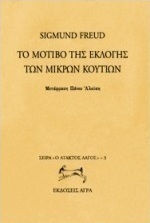
Το μοτίβο της εκλογής των μικρών κουτιών

Author: Sigmund Freud

This famous text by Sigmund Freud was first published in 1913. From his correspondence, it is concluded that the idea for this work came to him in June 1912. In a letter to Ferenzi, dated July 7,...

This famous text by Sigmund Freud was first published in 1913. From his correspondence, it is concluded that the idea for this work came to him in June 1912. In a letter to Ferenzi, dated July 7, 1913, he implied that a "subjective factor" played a role in the realization of this work, namely the fact that he himself had three daughters.

Two scenes from...

See full description See full description
  • Number of pages Number of pages 32
  • Cover Cover Soft
  • Year of publication Year of publication 1997
  • Publisher Publisher Agra
  • See all

6 79
Delivery Thu, 16 Jul - Mon, 20 Jul
14,00 €   shipping cost
Sent from Greece
From Ebooks 5.0 (27)
Greece
See Books on the page of Ebooks

Description

Description

This famous text by Sigmund Freud was first published in 1913. From his correspondence, it is concluded that the idea for this work came to him in June 1912. In a letter to Ferenzi, dated July 7, 1913, he implied that a "subjective factor" played a role in the realization of this work, namely the fact that he himself had three daughters.

Two scenes from Shakespeare provide Freud with the inspiration for this text. One is from "The Merchant of Venice," where the beautiful and wise Portia is called to choose a husband by selecting among three boxes made of gold, silver, and lead, which are offered to her by the three suitors competing for her hand. The other is from "King Lear," when, now old, he decides to divide his kingdom among his three daughters according to the love they express for him.

Freud relates these two scenes to myths and fairy tales, examining the motif of the three women either in relation to the role and origin of the mythical triadic gods of destiny (Fates, Hours, Graces, for example) or in relation to the function of the third sister or daughter in fairy tales (as seen in the Grimms' fairy tales, for example). Why does the choice lean towards the third? What do the boxes represent in the dream? What is the relationship of the choice to death? What is the process of substitution?

The retrospective adaptation attempted by the writer based on a myth, distorted by the transformation of desire, reveals its old meaning so clearly that it perhaps allows us an obvious, allegorical interpretation of the motif. We could say that those depicted here are the three inevitable relationships of a man with a woman: the fertile one, the companion, the destroyer. Or the three forms that the mother takes during her life.

Manufacturer

See full description

Specifications

Specifications

Author
Sigmund Freud
Publisher
Agra
Original Title
Das Motiv der Kästchenwahl
Language
Greek
Subtitle
-
Cover
Soft
Number of Pages
32
Release Date
12/1997
Publication Date
1997
Dimensions
14x21 cm
ISBN-13
9789603252030

Important information

Specifications are collected from official manufacturer websites. Please verify the specifications before proceeding with your final purchase. If you notice any problem you can report it here.

See all specifications

Description & Specifications

This famous text by Sigmund Freud was first published in 1913. From his correspondence, it is concluded that the idea for this work came to him in June 1912. In a letter to Ferenzi, dated July 7, 1913, he implied that a "subjective factor" played a role in the realization of this work, namely the fact that he himself had three daughters.

Two scenes from Shakespeare provide Freud with the inspiration for this text. One is from "The Merchant of Venice," where the beautiful and wise Portia is called to choose a husband by selecting among three boxes made of gold, silver, and lead, which are offered to her by the three suitors competing for her hand. The other is from "King Lear," when, now old, he decides to divide his kingdom among his three daughters according to the love they express for him.

Freud relates these two scenes to myths and fairy tales, examining the motif of the three women either in relation to the role and origin of the mythical triadic gods of destiny (Fates, Hours, Graces, for example) or in relation to the function of the third sister or daughter in fairy tales (as seen in the Grimms' fairy tales, for example). Why does the choice lean towards the third? What do the boxes represent in the dream? What is the relationship of the choice to death? What is the process of substitution?

The retrospective adaptation attempted by the writer based on a myth, distorted by the transformation of desire, reveals its old meaning so clearly that it perhaps allows us an obvious, allegorical interpretation of the motif. We could say that those depicted here are the three inevitable relationships of a man with a woman: the fertile one, the companion, the destroyer. Or the three forms that the mother takes during her life.

Manufacturer

Author
Sigmund Freud
Publisher
Agra
Original Title
Das Motiv der Kästchenwahl
Language
Greek
Subtitle
-
Cover
Soft
Number of Pages
32
Release Date
12/1997
Publication Date
1997
Dimensions
14x21 cm
ISBN-13
9789603252030

Important information

Specifications are collected from official manufacturer websites. Please verify the specifications before proceeding with your final purchase. If you notice any problem you can report it here.

6,79 €
14,00 €   shipping cost