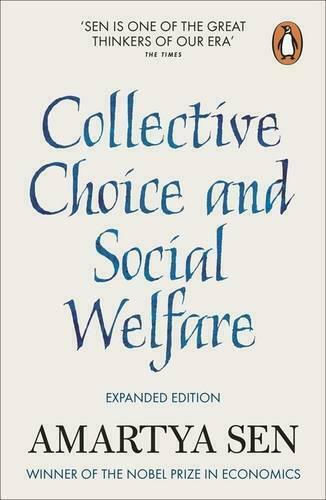
The first major book by Nobel laureate Amartya Sen has been reissued in a fully revised and expanded second edition. The book explores questions such as: Can the values that individual members of society assign to different alternatives be aggregated into values for society as a whole in a fair and theoretically correct manner? Is the principle of majority a functional rule for decision-making? How should income inequality be measured? When and how can we compare the distribution of well-being in different societies?
These questions refer to Sen's work in "Social Choice and Social Welfare," the most significant of all his early books. This work, originally published in 1970, has been recognized for its innovative role in uniting economics and ethics and for its influence on the development of new research areas in social choice. It has also significantly influenced international organizations such as the United Nations, particularly in their work on human development.
The expanded edition, which starts with reproducing the 1970 edition in its entirety, includes eleven new chapters with new positions and results. As in the original edition, the new chapters alternate between non-mathematical chapters fully accessible to everyone and those that present mathematical arguments and proofs. Readers who prefer to avoid mathematics can follow all the non-mathematical chapters on their own, to gain a complete, non-formal understanding. There is also a significant new introduction that offers an excellent overview of the subject of social choice.
Pages: 640, Dimensions: 12.9x12.9cm
 Number of pages
640
Number of pages
640
 Cover
Soft
Cover
Soft
 Year of publication
2017
Year of publication
2017
 Publisher
Penguin
Publisher
Penguin