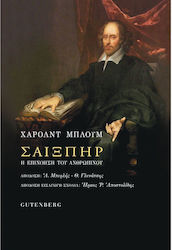
You can apply any interpretive key to Shakespeare, and you will see that the works will illuminate your interpretation – not the other way around. Although professional envious critics insist that the aesthetic stance constitutes on its own another "ideology," I disagree, engaging in this book exclusively with the aesthetic part of Shakespeare…
Harold Bloom, penetrating and critical, offers his readers detailed analyses of all Shakespearean works, composing a landmark book for the study of English and world Theater, as well as Literature in general.
Countless objections and discussions arise from his views and conclusions; however, that is how fruitful dialogue is, as ancient Greek inductive Thought has taught us. The classical yet multifaceted perspective of the American critic, imbued with Nietzschean tones and spirit, as well as the rich tradition of modern English idealism, guides us step by step through Hamlet, Iagos, and Falstaff, Cleopatras, Rosalinds, and Juliets, through A Midsummer Night's Dream and The Tempest, Henrys and Richards, into the marvelous worlds of Shakespeare, seeking the essence of his creation.
Contents:
- Bibliography-Abbreviations
- Publishing
- Editor's Introduction
- Thanks
- Timeline
- To the Reader
- The Universality of Shakespeare
- THE EARLY TRAGEDIES
- The Comedy of Errors
- The Taming of the Shrew
- The Two Gentlemen of Verona
- THE EARLY HISTORICAL DRAMAS
- Henry VI
- King John
- Richard III
- THE TRAGEDIES OF APPRENTICESHIP
- Titus Andronicus
- Romeo and Juliet
- Julius Caesar
- THE GREAT COMEDIES
- Love's Labour's Lost
- A Midsummer Night's Dream
- The Merchant of Venice
- Much Ado About Nothing
- As You Like It
- Twelfth Night
- THE MAJOR HISTORICAL DRAMAS
- Richard II
- Henry IV
- The Merry Wives of Windsor
- Henry V
- THE "UNSORTED" WORKS
- Troilus and Cressida
- All's Well That Ends Well
- Measure for Measure
- THE GREAT TRAGEDIES
- Hamlet
- Othello
- King Lear
- Macbeth
- Antony and Cleopatra
- TRAGIC EPILOGUE
- Coriolanus
- Timon of Athens
- THE LATER ROMANCES
- Pericles
- Cymbeline
- The Winter's Tale
- The Tempest
- Henry VIII
- The Two Noble Kinsmen
Conclusion: The Shakespearean Contribution
Postscript: On Self-Existence and Autonomy